
Over the past four articles, we explored three trends for 2026 and their implications for communicators.
We discussed how uncertainty makes narratives harder to land, how the revival of community-led communications demands a new kind of relevance, and how issues and crisis management have become universal expectations for every communicator.
Across these themes, one pattern stands out: while external factors evolve, the fundamentals of communication stay constant. The economy shifts, technology advances, and new platforms emerge — yet the principles that guide good communication remain unchanged. These enduring realities are what communicators can rely on when navigating an unpredictable world.
Our challenge, then, is not to chase the next trend or tool, but to strengthen our grasp of what never changes. The better we understand these fundamentals, the better we can apply them to new contexts.
The Realities That Don’t Change
There are several truths that continue to anchor the practice of communication, regardless of the year, the tools, or the trends. These truths form the foundation of every plan, campaign, and message we deliver.
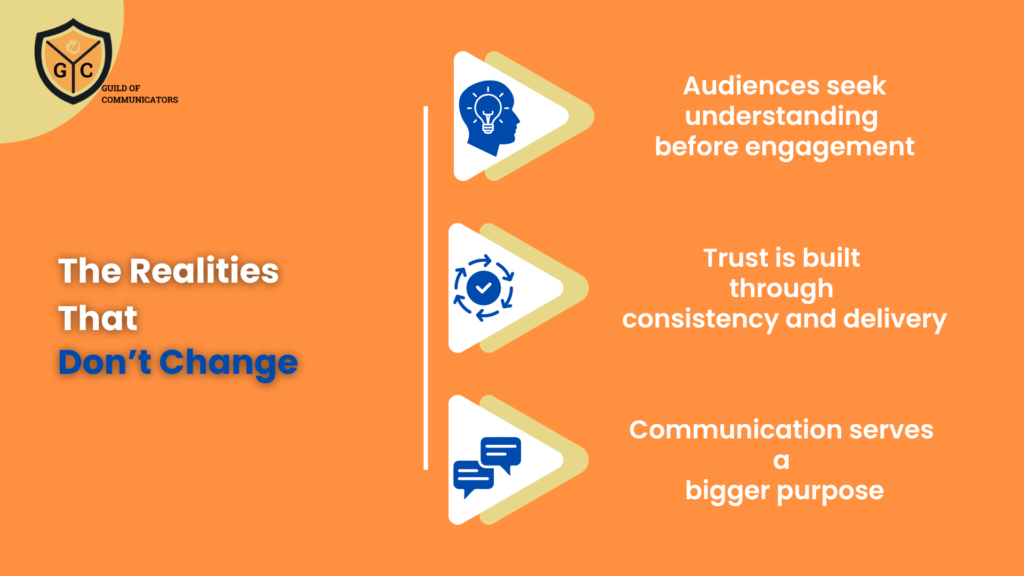
First, audiences seek understanding before engagement. People want to know why something matters to them before they decide to act or support it. Whether you’re communicating a policy update, a marketing message, or an internal announcement, clarity of intent remains the first step toward connection.
Second, trust is built through consistency and delivery. No communication strategy can succeed without credibility. Repetition of core messages, transparency in intentions, and alignment between words and actions remain the bedrock of trust-building — even as channels and tactics evolve.
Third, every communication effort serves a broader business or organisational purpose. Communicators must always align their work with outcomes that matter — not just visibility, but impact. Regardless of trends, communicators who understand this link between strategy and business value will continue to be indispensable.
These realities are constant. They are the quiet structure beneath every campaign, even when the environment around us feels chaotic.
The Risk of Short-Term Decisions
Despite knowing these fundamentals, many communicators still get caught in cycles of short-term thinking. This often happens when external pressures — quarterly metrics, campaign timelines, or shifting stakeholder expectations — push us to prioritise immediate results over long-term impact.
When communication becomes overly focused on short-term outputs, several things occur.
The first is fragmentation — messages lose coherence because they are crafted to serve temporary needs rather than a unified narrative. The second is reactivity — communicators respond to events as they happen instead of proactively shaping the conversation. The third is fatigue — teams become stretched by constant delivery without time to reflect or recalibrate.
Short-term thinking also affects the quality of work. It leads to surface-level creativity rather than strategic insight, and execution without evaluation. When communicators focus too heavily on producing content instead of building understanding, we lose sight of the very thing we are supposed to influence — meaning.
Recognising these patterns is important. Short-term results might bring quick wins, but long-term consistency builds credibility. And credibility is what sustains influence.
Reconnecting with the Fundamentals
To move beyond short-term cycles, communicators must consciously return to the fundamentals that do not change. This requires both awareness and discipline.
Start by reframing your role: your purpose is not just to communicate, but to create shared understanding that leads to alignment and action. This mindset helps you prioritise what truly matters in every plan or piece of content you create.
Next, ground your strategy in enduring principles. Every message should serve one of three purposes — to inform, to align, or to influence. These are the outcomes that never go out of date. When you build plans around them, your communication remains relevant even when tactics change.
Finally, strengthen your ability to interpret change through stable anchors. Instead of treating every new platform, regulation, or audience shift as something entirely new, interpret them through the lens of what you already know to be true about human behaviour and organisational communication. This is how communicators evolve without losing direction.
Those who focus on these fundamentals will not only adapt faster but also lead conversations with more confidence and clarity.
The Psychology of Novelty and Distraction
It is natural for communicators to be drawn toward new ideas and trends. In fact, our profession values curiosity and adaptability. But there are psychological reasons why this attraction can also become a distraction if unchecked.
Novelty bias explains our preference for new information. The brain rewards us with dopamine when we encounter something unfamiliar — which is why the latest tool or trend can feel more exciting than refining established practices. This drive for stimulation, while useful for creativity, can pull focus away from the fundamentals that sustain quality.
Hedonic adaptation also plays a role. Once we adopt a new practice or technology, its benefits quickly become normalised, and we begin seeking the next innovation to regain the same sense of progress. This creates a cycle where communicators constantly move toward “what’s next” rather than “what’s right”.
Lastly, the shiny object syndrome — a behavioural pattern of chasing appealing but ultimately non-essential ideas — often emerges when communicators are under pressure to deliver visible results. It feels easier to try something new than to improve what already works.
Understanding these psychological tendencies helps communicators stay balanced. The goal is not to reject innovation, but to integrate it meaningfully. Curiosity should inform progress, not replace it.
Preparing for 2026 — Principles for Communicators
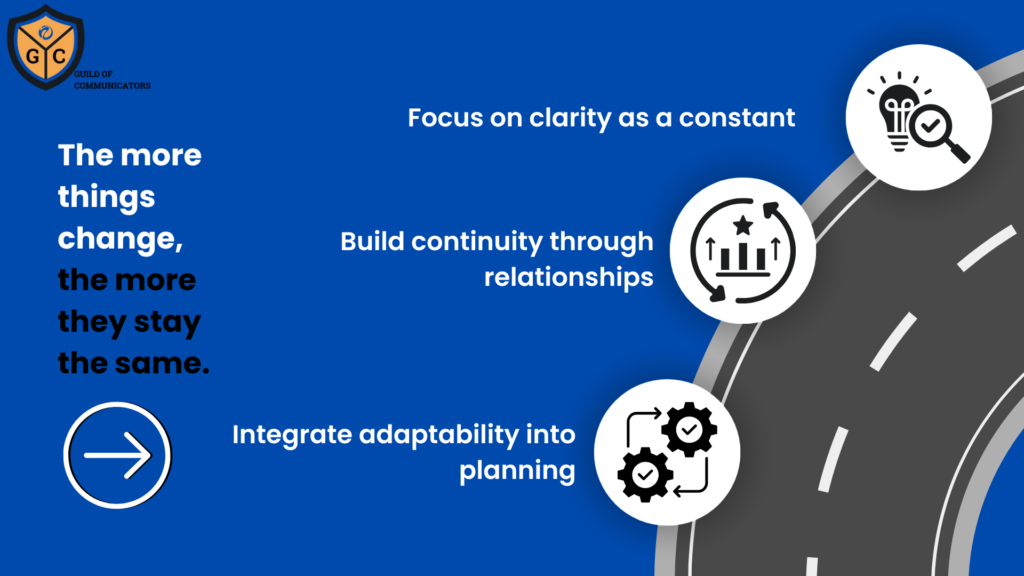
The more things change, the more they stay the same. Technology, trends, and tools will continue to evolve, but the communicator’s responsibility will not. Our work remains about building understanding, alignment, and trust.
As we look ahead to 2026, communicators can prepare by grounding themselves in three enduring principles that support long-term effectiveness.
1. Focus on clarity as a constant.
Clarity is what enables organisations to act and audiences to trust. Communicators should continuously refine how they simplify complex ideas.
Practical action: Build message templates that reduce ambiguity — for example, a three-part structure explaining the “what”, “why”, and “how” of every key message. Revisit them regularly to maintain consistency across teams and campaigns.
2. Build continuity through relationships.
Strong relationships make communication resilient. When uncertainty arises, trust between communicators and stakeholders allows for faster, more confident decision-making.
Practical action: Strengthen internal communication loops. Create regular checkpoints with cross-functional teams to maintain alignment and reduce siloes. Externally, invest in community-building rather than one-time engagement.
3. Integrate adaptability into planning.
Change will continue, but communicators can prepare for it by designing flexibility into their plans. This includes anticipating scenarios and developing pre-approved frameworks for response.
Practical action: Create adaptable playbooks that outline communication protocols for different risk or opportunity levels. Ensure teams know not just what to say, but how to decide when and how to act.
These principles represent the bridge between enduring fundamentals and the realities of modern communication. By focusing on clarity, continuity, and adaptability, communicators stay prepared for both what is known and what is yet to come.
For 2026 and beyond, the communicators who will thrive are those who can balance curiosity with discipline — those who see change not as chaos, but as context. The fundamentals are not static; they are the steady points that allow us to move with confidence through what’s next.
If the world demands agility, then clarity and consistency will be our greatest strengths.
*****
Ready to elevate your communications career? The Guild of Communicators is your essential hub for professional growth, offering a vibrant community and best-in-class resources.
- Connect Membership: Ideal for early-career communicators seeking a supportive peer network, over 300 foundational and intermediate courses, and monthly interactive group sessions.
- Elevate Membership: For ambitious professionals, this tier includes premium frameworks, immersive live online workshops, dedicated career coaching, and mentorship with senior industry leaders.
Discover your path to impact and accelerated career growth.
Join the Guild of Communicators today at www.gocommunicators.com.
(For students: If you’re a student, undergraduate or postgraduate, explore our special student referral programme to lock in your membership fee for the second year! Drop us an email to find out more)
——-
Subscribe to join over 1500+ communicators and brands getting value every Tuesday while reading A Communicator’s Perspective, our weekly newsletter.