Communicators struggle to articulate the impact of their work on organisational goals.
It is so easy to equate activity with achievement. We send press releases, post on social media, and organise events, assuming that because we are visible, we are valuable.
However, visibility is not the same as impact.
True impact is about driving measurable outcomes that align with organisational priorities. For communicators, the most important professional shift you can make is to stop measuring how loud you are and start measuring the difference you make.
Relying on Surface-Level Metrics
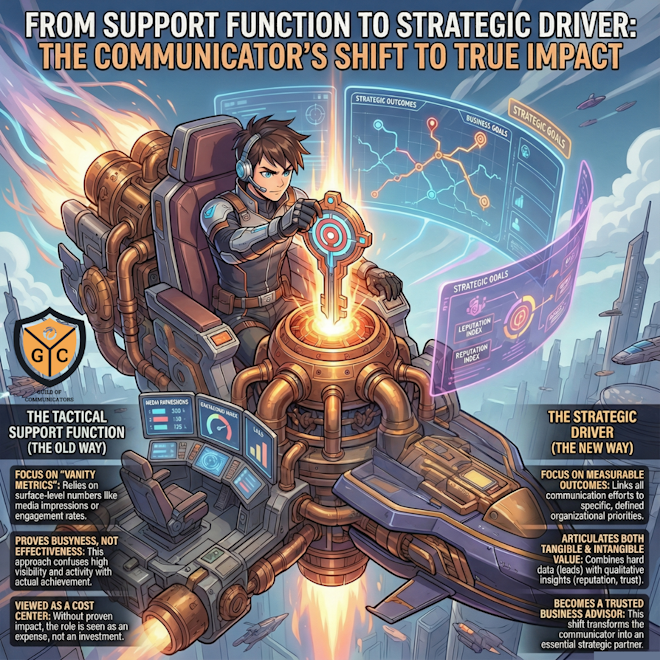
The primary challenge for many in the industry is that success is often measured by surface-level metrics like media impressions or engagement rates. These are “vanity metrics”—numbers that look impressive on a slide but say very little about the actual health or success of the business.
It is tempting to report that a campaign reached one million people, but if that reach did not influence stakeholder perceptions, build trust, or support business objectives, its value is questionable.
When communicators focus solely on these tangible outputs, they leave the true value of communication unclear.
You may be able to prove you were busy, but you cannot prove you were effective. This creates a disconnect between the communication function and the leadership team, who are focused on growth, reputation, and risk mitigation rather than likes and shares.

Remaining a Support Function
The long-term consequence of confusing visibility with impact is that communication remains a tactical support function rather than a strategic driver. If you cannot demonstrate how your work contributes to the bottom line or the organisation’s reputation, you will struggle to secure budget, resources, or a seat at the decision-making table.
Furthermore, communicators often focus on tangible results like media coverage while overlooking the intangible value their work creates. This leads to an incomplete understanding of the broader impact of communication efforts.
Without a clear definition of impact, your strategic contributions go unnoticed, and you risk being viewed as a cost centre that produces content, rather than an investment that generates value.
Understanding True Organisational Value
When you shift your focus to defining and delivering true impact, the benefits are immediate and substantial. Impact is about outcomes, such as influencing stakeholder perceptions or building trust. It encompasses both tangible impact, which is measurable like lead generation, and intangible impact, like enhanced trust and reputation.
Recognising both types of impact allows you to articulate the full scope of how communication drives organisational success. This approach strengthens your credibility and positions communication as a strategic driver of success. You become a partner who understands the business, not just a specialist who understands the media. This alignment ensures that stakeholders see the relevance of your work to their specific priorities.
Why We Cling to Vanity Metrics
Why is it so difficult to move away from visibility metrics?
Psychologically, humans prefer certainty and immediate gratification. Surface-level metrics like impressions are easy to access, easy to count, and provide an instant dopamine hit of “success”. We can see the numbers go up in real-time.
Real impact—such as a shift in public sentiment or an increase in brand trust—is abstract, harder to measure, and takes time to materialise. It requires a level of analysis and patience that feels less rewarding in the short term.
Additionally, there is often a fear that if we dig deeper into the data, the results might not be as favourable as the vanity metrics suggest. Staying in the comfort zone of visibility protects us from the difficult questions about the actual effectiveness of our strategy.
Three Principles for Defining Impact
Defining impact is the first step in maturing as a strategic communicator. It requires the courage to look beyond the easy numbers and the discipline to align your work with the hard realities of business objectives.
To move from visibility to impact, you must adopt a disciplined approach to how you define and measure success.
- Define What Impact Means to Your Organisation. Impact is not a generic concept; it varies from business to business. Start by defining what impact means specifically to your organisation. Does it mean changing the perception of a key stakeholder group? Does it mean mitigating a specific regulatory risk? Does it mean driving qualified leads for the sales team? You cannot hit a target you have not defined.
- Articulate Both Tangible and Intangible Value. Do not limit yourself to what is easily counted. Recognise and articulate both tangible and intangible types of impact. While you should use data to showcase tangible results like brand awareness, you must also use storytelling and qualitative insights to illustrate intangible contributions like goodwill and reputation. Together, they define the true value of communication.
- Link Campaigns to Specific Outcomes. Never launch a campaign without a clear destination. Link your campaigns to specific outcomes and measure progress against those goals. Instead of reporting “we launched a newsletter,” report “the newsletter educated employees on the new strategy, resulting in a 10% increase in internal alignment scores.” Communicate these results clearly to stakeholders to demonstrate the “why” behind your efforts.
By clearly distinguishing between being seen and making a difference, you ensure that your work is not just noticed, but valued. This shift in perspective is what transforms a communicator from a tactical executor into a trusted business advisor.
To help you navigate the journey, I have designed an exclusive infographic. Complete the form below to join A Communicator’s Perspective—our weekly newsletter for growth-minded professionals—and receive this essential infographic directly to your inbox.