As a communicator, you intuitively understand the power of trust, reputation, and goodwill. You know that these “intangible” assets are the bedrock of any successful organisation.
However, sitting across the table from a CFO or a sales director and explaining the value of “sentiment” can feel like speaking a different language. While you speak in qualitative terms, they often expect quantitative proof.
This disconnect creates a significant hurdle: discussing intangible impacts such as trust or reputation with stakeholders can feel challenging because these concepts lack immediate, concrete metrics.
To bridge this gap, you must learn to translate the invisible value you create into the visible business outcomes your stakeholders care about.
Communicating the Abstract
The core challenge lies in the inherent nature of the work. Intangibles are inherently abstract, yet they drive critical outcomes like stakeholder loyalty and long-term growth.
Unlike sales figures or operational costs, you cannot easily put a price tag on a reputation saved or a crisis averted.
Communicators often struggle to effectively convey the impact of their work to stakeholders because of this ambiguity. When you report on “brand health” or “engagement,” it can sound vague to a stakeholder focused on next quarter’s revenue.
The key challenge lies in bridging the gap between qualitative value and the quantitative focus many stakeholders expect. Without a translation layer, your most strategic work risks being dismissed as “fluff.”

Misunderstanding Strategic Value
When communicators fail to bridge this gap, the consequences are severe. Without a clear narrative and lack of clarity on direction by leadership or stakeholders, the value of strategic communication can be misunderstood or undervalued. If stakeholders cannot see the direct line between your efforts and their priorities, they will assume there isn’t one.
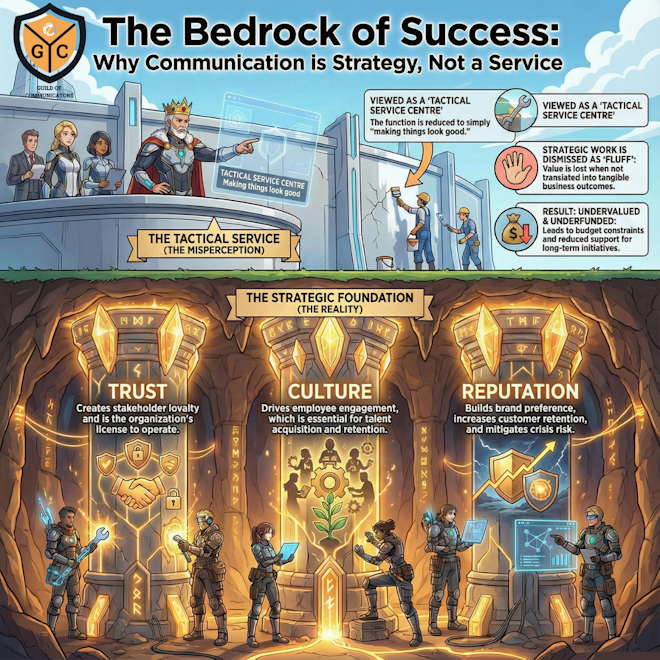
This leads to misalignment. Stakeholders may view communication as a tactical service centre—there to “make things look good”—rather than a strategic partner there to solve business problems.
This misunderstanding often results in reduced support for long-term initiatives, budget constraints, and a general undervaluation of the communication function’s role in the organisation’s success.
Creating Shared Understanding
On the other hand, when you successfully articulate the value of intangibles, you foster deep alignment. Stakeholders need to see how communication efforts connect to their priorities, such as driving business growth, building trust, or mitigating risks. When you make this connection, you transform the relationship.
Framing the conversation around outcomes rather than outputs ensures alignment and fosters understanding. It builds a shared language where stakeholders recognise that “reputation” means “customer retention” and “trust” means “licence to operate.”
This strengthens relationships and positions communication as an essential driver of organisational success, turning sceptics into advocates.
The Preference for Hard Numbers
To navigate these conversations effectively, it helps to understand the psychology behind the resistance.
Business leaders are trained to manage what they can measure. There is a cognitive bias towards “hard” data—numbers that are concrete, comparable, and seemingly objective. Intangible concepts introduce ambiguity and uncertainty, which the corporate brain is wired to minimise.
This makes it harder to prove their value in traditional business terms. The resistance isn’t usually personal; it is structural. Stakeholders are accountable for specific KPIs, and if they cannot clearly see how your “intangible” value impacts their “tangible” targets, they will naturally deprioritise it.
Overcoming this requires you to respect their need for certainty while guiding them to see the value in the abstract.
Three Principles for Effective Dialogue
Talking about intangible value is one of the most sophisticated skills a communicator can develop. It requires you to step out of your own professional jargon and step into the world of your stakeholders. It forces you to think like a business leader first and a communicator second.
You do not need to invent new metrics to solve this; you need to change the narrative. Here are three principles to help you discuss invisible value effectively.
- Frame Around Business Outcomes. Stop talking about communication outputs and start talking about business outcomes. Frame intangible impacts in terms of their real-world outcomes. Instead of reporting on “positive sentiment,” explain how that sentiment contributes to “customer retention” or “talent acquisition.” Stakeholders need to see how communication efforts connect to their priorities. If you are talking to HR, frame trust as employee engagement; if you are talking to Sales, frame reputation as brand preference.
- Connect the Dots with Storytelling and Proxy Metrics. You must bridge the gap between the qualitative and the quantitative. Use stories, case studies, and proxy metrics to connect the dots between intangible value and measurable organisational benefits. For example, use a specific case study to show how a strong reputation helped navigate a regulatory challenge. Use proxy metrics—like a drop in customer complaints or an increase in positive reviews—to give a hard edge to soft concepts.
- Lead with Data and Context. Never enter the room with just an opinion. Approach these discussions with data and context. Highlight how your work supports their goals, share relevant metrics, and explain the “why” behind your efforts. Data provides the credibility stakeholders need to trust your qualitative insights. When you back up a claim about “trust” with data showing a trend in stakeholder advocacy, you move the conversation from feeling to fact.
By systematically connecting the “invisible” work you do to the “visible” results they want, you ensure that the foundational elements of your organisation—trust, reputation, and culture—are given the strategic weight they deserve.
These approaches build understanding and reinforces the strategic role of communication.
To help you navigate the journey, I have designed an exclusive infographic. Complete the form below to join A Communicator’s Perspective—our weekly newsletter for growth-minded professionals—and receive this essential infographic directly to your inbox.