The communication plan is often viewed as a logistical document—a calendar of events, a list of press releases to be drafted, or a schedule of social media posts to be published.
Many communicators approach the planning phase with a focus on volume and cadence, asking questions like “How many times should we post?” or “When should we launch the newsletter?”
While these logistical details are necessary for execution, they do not constitute a strategy. When a plan is built solely around activities, it becomes a “to-do” list rather than a roadmap for business success. This approach leaves the potential impact of the work unclear and disconnected from the broader organisational reality.
True strategic impact does not happen by accident; it must be engineered from the very beginning. A communication plan designed for impact requires a fundamental shift in approach. It must start with the end in mind, defining the specific outcomes the organisation needs to achieve before a single tactic is conceived.
Furthermore, it requires the communicator to step out of their function and engage with the business leaders they support. It transforms the planning process from a solitary administrative task into a strategic negotiation on what the organisation values and how communication will deliver it.
For the communicator, learning to design for impact is the critical step that bridges the gap between being a busy content creator and a valued strategic partner.
Understanding the Activity Trap
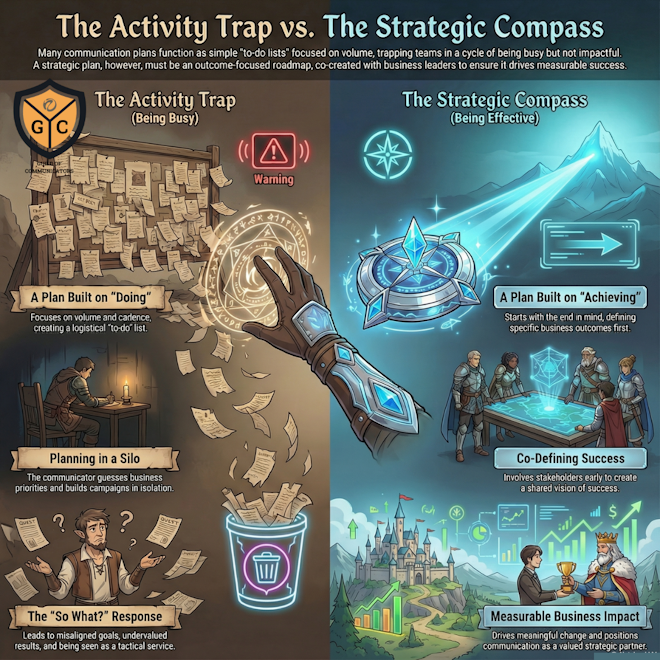
The most significant challenge preventing impactful communication is the tendency to plan in isolation. For many communicators, the planning process is treated as a solo effort—a period of heads-down work where strategies are crafted behind closed doors, based on the communicator’s own assumptions about what is important. You might look at the company’s annual report, make an educated guess about the priorities, and then retreat to your desk to build a campaign that you believe fits the brief.
This isolation creates a dangerous disconnect. While you are designing a campaign to maximise media impressions or boost employee open rates, your stakeholders in Sales, Operations, or HR may be losing sleep over completely different metrics, such as lead quality, employee retention, or supply chain reputation.
When you plan in a silo, you are effectively guessing the target. You might execute a flawless campaign that meets all your internal standards of excellence yet fails to address the actual pressure points of the business.
This “activity trap” creates a false sense of productivity, where the communication function is incredibly busy but ultimately irrelevant to the strategic direction of the company.
Recognising the Risk of Solo Planning
The consequences of this isolationist approach become painfully clear when it is time to report results. Leaving stakeholders out of the planning process almost inevitably leads to misaligned expectations and undervalued results.
Imagine presenting a report that highlights a 20 percent increase in website traffic, only to be met with blank stares because the leadership team was expecting an increase in qualified leads. In this scenario, you have succeeded in your metrics but failed in theirs.
This misalignment triggers the “So what?” response.
Stakeholders see the data, but they do not see the value. If you have not agreed on the destination at the start, you cannot agree on whether the journey was successful. Over time, this erodes the credibility of the communication function.
Stakeholders begin to view communication as a tactical service centre—a department that “makes things look pretty” or “sends the emails”—rather than a strategic lever that drives business performance.
Without a clear connection to organisational goals, it becomes difficult to justify budgets, secure resources, or gain the executive support needed to expand your team or your scope. The long-term consequence is professional stagnation, where the communicator is pigeonholed as an executor rather than a leader.
Capitalising on Shared Goals
Conversely, when you dismantle the silo and invite collaboration, the dynamic shifts entirely. Collaboration with stakeholders is essential to identify what success looks like from their perspective. By co-defining goals and metrics before the plan is written, you create a shared understanding of what constitutes meaningful impact.
This is not just about getting approval; it is about building a shared vision of success.
When stakeholders are involved in the planning process, they transition from passive recipients of your services to active co-owners of the strategy. They become invested in the results because they helped define the objectives.
If a campaign faces challenges, they are more likely to support adjustments rather than assign blame, because they understand the strategic intent. This partnership-driven strategy validates your work in real-time. It builds a reservoir of trust that allows you to take bigger risks and propose more ambitious initiatives in the future.
You are no longer fighting to prove your worth at the end of the quarter; your worth is established at the start of the quarter through the very act of strategic alignment.
Exploring the Fear of Collaboration
If collaboration is so beneficial, why is planning in isolation such a common default?
The psychology behind this often stems from a mix of perfectionism and a misunderstanding of expertise. Many communicators feel a pressure to present a “finished” product. There is a fear that asking for input early in the process implies a lack of knowledge or competence. We worry that if we ask a stakeholder “What should we be measuring?”, it sounds like we do not know how to do our jobs.
Additionally, involving stakeholders introduces variables that are out of our control. It opens the door to conflicting opinions, shifting priorities, and feedback that might derail our creative vision.
Planning alone provides a sense of control and safety. We can ensure the plan looks perfect, the timeline is realistic, and the tactics are within our comfort zone. However, this desire for control is counterproductive.
Strategic maturity involves recognising that communication does not exist in a vacuum. It requires the confidence to facilitate a conversation about business needs, rather than just delivering a monologue about communication tactics. The discomfort of collaboration is the price of relevance.
Applying an Outcome-First Approach
Designing for impact is not just a matter of better metrics; it is a matter of fundamental strategic alignment. It requires the courage to pause the “production line” of content and invest time in the difficult, often messy conversations about business value.
By shifting your focus from “what we will do” to “what we will achieve,” and by bringing stakeholders into that conversation from day one, you ensure that your communication efforts drive meaningful, measurable change.
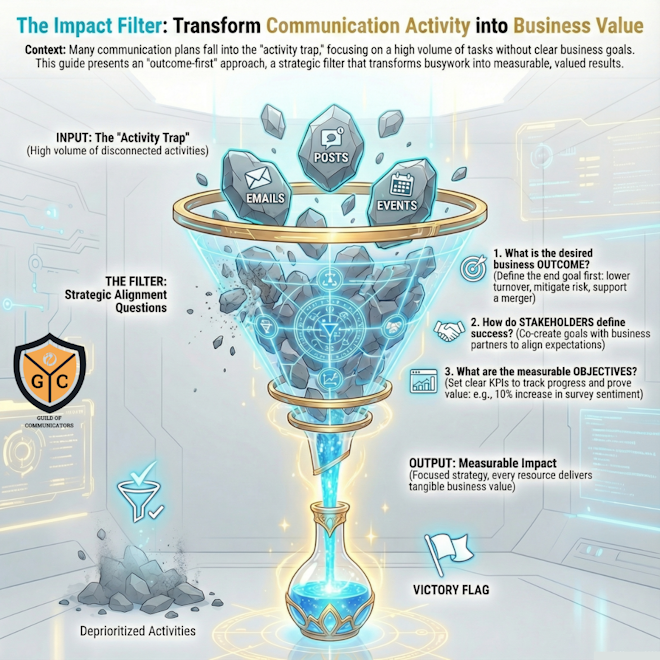
To ensure your communication plan drives measurable change, you must integrate impact into the design phase. This requires a disciplined adherence to three core principles.
1. Start with the Outcomes: A communication plan designed for impact must start with the end in mind. Before you list a single tactic, channel, or timeline, you must define the specific outcomes you want to achieve. Move beyond vague aspirations like “raise awareness” and define precisely what that awareness should achieve. Are you shaping perceptions to support a merger? Are you driving engagement to lower turnover? Are you building trust to mitigate regulatory risk?.
Once the outcome is defined, align every activity with that goal. Treat your plan as a filter. If a proposed activity—no matter how creative or popular—does not directly contribute to the agreed outcome, it should be removed or deprioritised. This ruthlessness ensures that your resources are focused entirely on driving impact, preventing the “scope creep” of low-value administrative tasks.
2. Co-Define Success with Stakeholders: Do not guess what your stakeholders value; ask them. Engage stakeholders early to agree on objectives and measurement criteria. Schedule discovery sessions with your partners in Sales, HR, Operations, or Executive Leadership before you draft the plan. Ask direct questions: “What is the biggest challenge your department faces this quarter?” “What does success look like for you in six months?” “How will you measure that success?”
By co-defining goals, you ensure that your plan is solving real business problems. This process also helps you manage expectations. If a stakeholder wants an impossible outcome, it is better to have that conversation during the planning phase than to disappoint them at the reporting phase. This shared agreement becomes the “contract” for your strategy, ensuring everyone is working towards the same definition of success.
3. Build Around Measurable Objectives: Once the outcomes are agreed upon, build your plan around measurable objectives and clear priorities. Use Key Performance Indicators (KPIs) to track progress. If the goal is to improve employee retention (intangible impact), the measurable objective might be “Increase positive sentiment in the employee pulse survey by 10 percent.” If the goal is sales support (tangible impact), the objective might be “Generate 50 marketing-qualified leads from the whitepaper launch.”
Critically, use regular check-ins to review progress and refine your approach. A strategic plan is not a static document; it is a living framework. If the data shows that a tactic is not delivering the expected impact, you must be willing to pivot. This dynamic approach ensures that your plan remains relevant and impact-focused throughout its lifecycle, demonstrating to stakeholders that you are managing for results, not just for activity.
This collaborative, outcome-led approach is what separates a tactical coordinator from a strategic leader. It ensures that when you deliver results, they are not just numbers on a page, but results that the organisation values, understands, and celebrates.
To help you navigate the journey, I have designed an exclusive infographic. Complete the form below to join A Communicator’s Perspective—our weekly newsletter for growth-minded professionals—and receive this essential infographic directly to your inbox.