In a previous article, we explored three trends that will define 2026 for communicators: harder-to-land narratives in an uncertain environment, the revival of community-led communication, and the broadening of crisis and issues management across teams.
Each trend reflects a recurring theme — the need to stay grounded in fundamentals while guiding organisations through shifting conditions.
Let’s take a deeper look at the first trend: uncertainty and harder-to-land narratives. The challenge is not that audiences have stopped listening, but that the conditions under which they interpret information have become unstable. Decision-makers face new constraints, consumers receive more contradictory messages, and stakeholders are more cautious about who they trust.
Amid this, communicators must step up as the interpreters of complexity — to bring clarity and structure where ambiguity dominates. This is not a new role, but it has become more urgent and more visible.
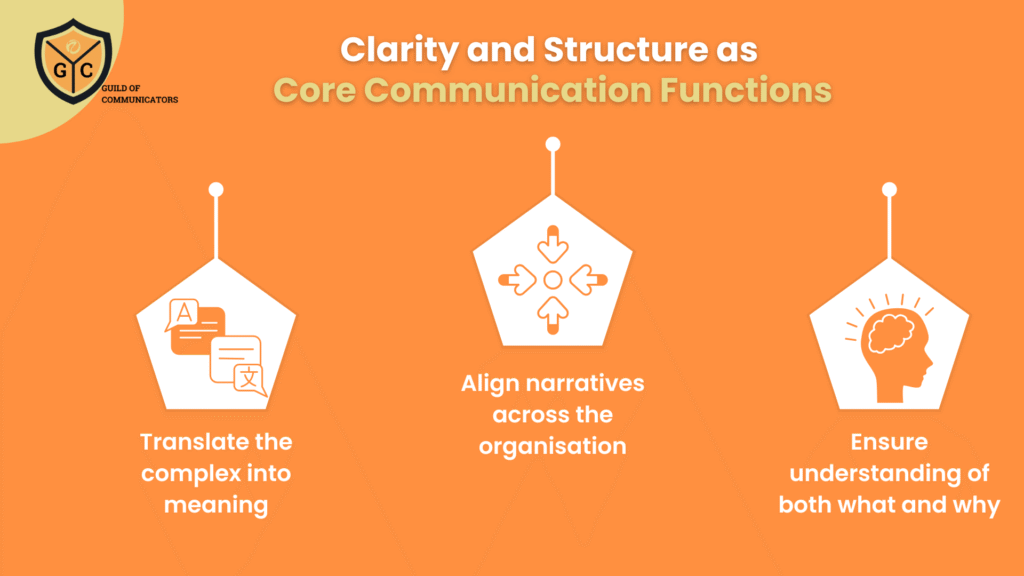
Clarity and Structure as Core Communication Functions
Bringing clarity and structure means translating complexity into meaning, aligning narratives across departments and functions, while ensuring stakeholders can understand both what is happening and why it matters.
It is not only about writing or messaging — it is about helping others think clearly in times of uncertainty.
This responsibility often extends beyond the traditional boundaries of communication work. When communicators help teams interpret market movements, customer sentiment, or regulatory shifts, they are providing strategic value, not just information. They turn fragmented updates into coherent stories that help leadership make informed decisions and employees see how their work fits into the organisation’s broader direction.
Clarity also builds confidence. In moments when strategy feels uncertain or priorities shift, structured communication gives people something to hold on to — a framework for understanding what remains stable and what is changing. This function makes communicators integral to organisational resilience.
The Cost of Operating in Ambiguity
When communication itself becomes unclear, the organisation risks losing trust and direction. In highly ambiguous situations — where priorities, timelines, and ownerships are fluid — communicators can quickly find themselves excluded from key discussions or seen as tactical executors rather than strategic partners.
Operating in such an environment often leads to misalignment across teams. Without a shared understanding of what the message should be, outputs become inconsistent and reactive. The result is a loss of credibility, both internally and externally. Teams start communicating based on assumptions rather than shared truths.
To prevent this, communicators must proactively assert their role as the bridge between information, strategy, and perception. This means creating a common frame of reference for discussions — summarising key developments, documenting decisions, and maintaining message discipline. Even when the environment is fluid, structure gives direction.
Layers of Uncertainty Across the Landscape
Today’s uncertainty is not one-dimensional. It operates across multiple layers — regulatory, economic, and technological — and each has its own rhythm of change.
Regulations are shifting as governments adapt to digital transformation and sustainability demands. Economies are adjusting to uneven recovery cycles and evolving trade conditions. Technology continues to reshape how consumers interact, make decisions, and form communities.
For communicators, this means that while the external environment moves fast, consumer behaviour often does not. Trust and confidence take time to rebuild after each disruption. People are cautious, and their attention is fragmented. In such conditions, a brand’s stability becomes part of its message — consistency signals reliability.
Communicators play a central role in projecting that stability. Whether speaking to investors, employees, or customers, they must communicate assurance without overpromising certainty. The goal is not to remove complexity, but to help audiences understand it and make confident choices despite it.
Understanding the Psychology of Uncertainty
How people and organisations respond to uncertainty is not uniform. Psychology offers useful insight into these patterns.
At the organisational level, uncertainty avoidance often drives the need for control and predictability. When markets or policies shift, leadership may tighten communication approval processes or delay announcements to minimise perceived risk. Communicators must recognise this tendency and frame clarity as a risk mitigation tool — showing how timely, structured updates reduce confusion rather than create exposure.
Within teams or communities, groupthink and emotional contagion can shape collective reactions. When uncertainty spreads, people take cues from peers, and negative emotions can multiply quickly. In such contexts, communication must model calm, consistent language and reinforce shared values to restore collective confidence.
At the individual level, information overload is the main challenge. When people face too many updates, they tune out or misinterpret key messages. Communicators should therefore simplify presentation, use consistent terminology, and avoid assuming frequency equals effectiveness. The task is to help audiences process — not just receive — information.
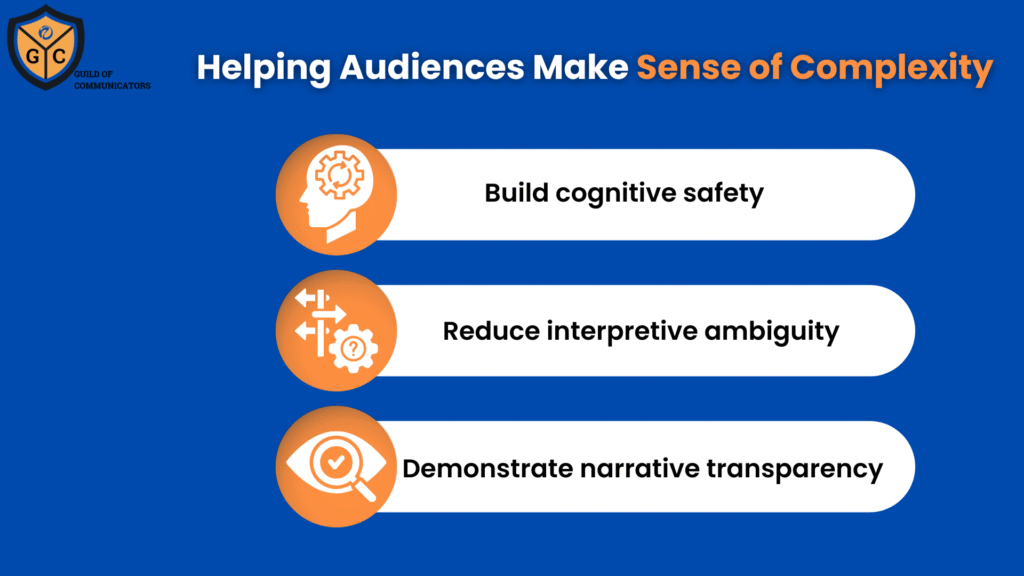
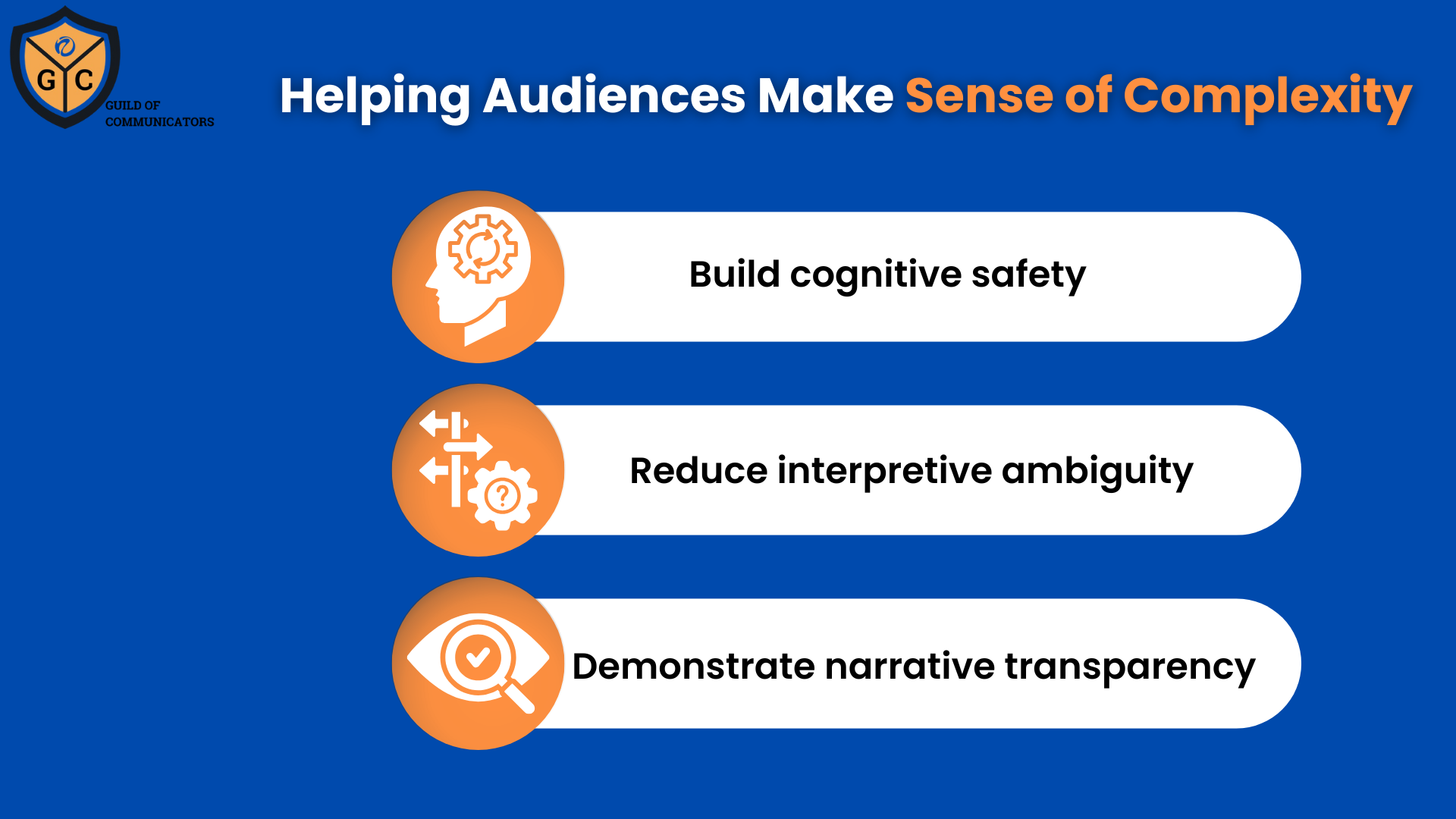
Helping Audiences Make Sense of Complexity
The world is unlikely to become less complex, but communicators can make it more comprehensible. Their ability to structure information, anticipate reactions, and guide understanding will continue to define their value in 2026 and beyond.
To communicate effectively in an uncertain environment, communicators can apply three guiding principles that bridge psychological insight with practical action.
1. Build cognitive safety
Audiences — whether internal teams or external stakeholders — are more open to information when they feel secure in their ability to understand and respond. Communicators can build cognitive safety by explaining the reasoning behind decisions, acknowledging uncertainty where it exists, and providing clear next steps. Predictable formats, such as regular updates or consistent framing, help reinforce stability.
2. Reduce interpretive ambiguity
Ambiguity often stems from unclear intentions or inconsistent phrasing. To reduce it, communicators should use language that clarifies intent and distinguishes between facts, opinions, and expectations. Supporting narratives with data, examples, and defined outcomes makes it easier for audiences to interpret meaning accurately and consistently.
3. Demonstrate narrative transparency
Trust increases when communicators show how a narrative is formed — what assumptions were made, what trade-offs exist, and what the organisation is learning as it moves forward. Practical actions include publishing rationale summaries, engaging in open Q&A formats, or sharing behind-the-scenes insights into decision-making. Transparency strengthens credibility even when answers are incomplete.
By focusing on clarity, stability, and transparency, communicators not only protect their organisation’s reputation but also help build the public’s confidence in navigating change. In a time when many messages compete for attention, clarity is both a service and a strategy.
*****
Ready to elevate your communications career? The Guild of Communicators is your essential hub for professional growth, offering a vibrant community and best-in-class resources.
- Connect Membership: Ideal for early-career communicators seeking a supportive peer network, over 300 foundational and intermediate courses, and monthly interactive group sessions.
- Elevate Membership: For ambitious professionals, this tier includes premium frameworks, immersive live online workshops, dedicated career coaching, and mentorship with senior industry leaders.
Discover your path to impact and accelerated career growth.
Join the Guild of Communicators today at www.gocommunicators.com.
(For students: If you’re a student, undergraduate or postgraduate, explore our special student referral programme to lock in your membership fee for the second year! Drop us an email to find out more)
——-
Subscribe to join over 1500+ communicators and brands getting value every Tuesday while reading A Communicator’s Perspective, our weekly newsletter.