In a recent overview of trends for 2026, we identified three developments that will shape communication practice: narratives that are harder to land amid growing uncertainty; the revival of community-led communications that bridge online and offline; and the mainstreaming of issues and crisis management. The first two trends affect how messages are formed and where conversations happen. The third trend changes who must be ready to act and how quickly.
This article drills into that third trend.
Issues and crises are no longer peripheral responsibilities reserved for a few specialists. They now surface more frequently, and they demand a baseline capability across teams. For communicators, this shift is not an added burden so much as a change in the professional baseline: preparedness, rapid judgement and coordinated action are expected.
Understanding why this change has occurred and how communicators should respond helps make the role clearer.
When issues became mainstream
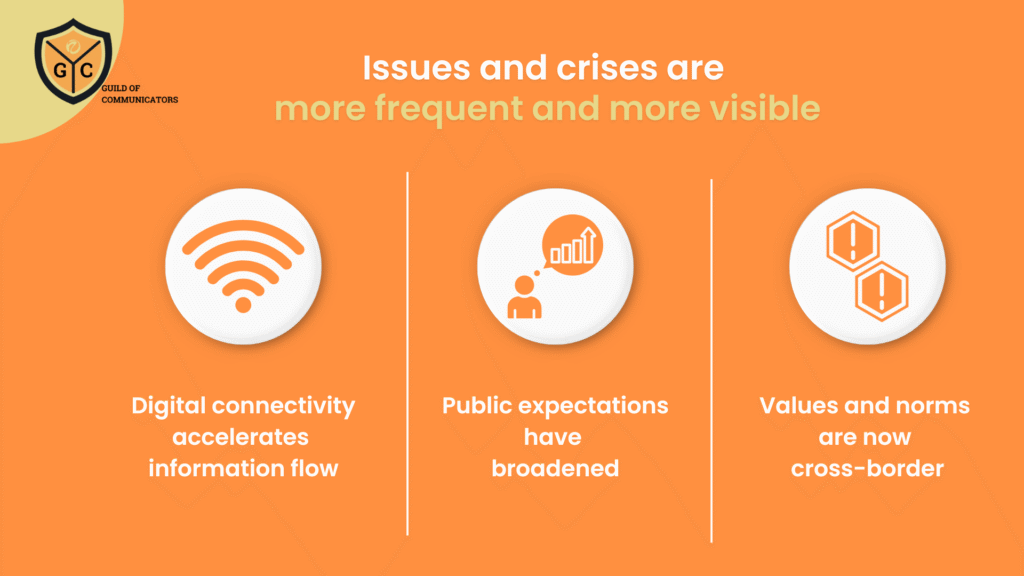
Issues and crises have become more frequent and more visible for several linked reasons.
First, digital connectivity accelerates information flow. Incidents that were once local can now spread across stakeholder groups within hours. Second, public expectations about corporate behaviour have broadened: audiences judge brands on sustainability, ethics and social responsibility as part of a single reputation assessment. Third, demographic shifts mean values and norms that once varied by region now cross borders; cohorts share concerns and amplify them via social platforms.
This change is also organisational. Many companies now publish more, operate more publicly and engage directly with stakeholders across channels. That openness is positive, but it also exposes more points where issues can start. Small operational glitches, employee grievances or supplier problems can attract attention and link together into a larger narrative if not addressed coherently.
Because of these conditions, issues are no longer rare exceptions to normal operations. They are part of the operating environment.
That requires a shift in capability: organisations must assume that an issue will emerge and be prepared to act accordingly rather than treating response as a specialist, reactive task.
What happens when communicators are sidelined
When brands try to resolve issues without communicators guiding or steering the effort, problems stack up quickly.
Technical fixes or legal responses may address surface symptoms but fail to consider perception, tone or long-term credibility. A disjointed response—where different departments issue inconsistent statements or where internal stakeholders receive different messages—creates confusion and fuels suspicion.
Second, excluding communicators slows decision cycles. Communicators are trained to translate complex issues into simple, actionable messages for different audiences and channels. Without that translation function, the organisation risks mixed signals, missed opportunities to reassure key stakeholders, and increased likelihood of misinterpretation across media and social platforms.
Third, failure to involve communicators damages trust. Stakeholders measure both what is done and how it is explained. An error resolved quietly but poorly explained can leave residual doubt; conversely, a transparent response shaped with communication in mind can strengthen credibility. Sidelining communicators removes the chance to shape that narrative proactively.
How communicators should think and feel about this shift
Communicators must adopt a proactive, ownership mindset. That does not mean taking control of every operational decision; it means asserting the value of communication in shaping outcomes and ensuring the organisation acts with cohesive intent.
Being proactive requires readiness—scenario planning, pre-approved language, and clear escalation pathways—not last-minute fixes.
At the same time, communicators should view this shift as an elevation of their professional role. Being involved early makes the work more strategic: you influence not only how issues are explained but which actions are taken, helping align response with long-term reputation goals. That responsibility brings pressure, but it also builds credibility and influence within the organisation.
Finally, it is important to be calm and principled. Issues test composure; those who are steady, methodical and clear in a crisis earn trust. Embrace that expectation as part of professional development: develop the processes, relationships and judgement needed to perform under pressure.
Using psychology to lead: clarity, steadfastness, decisiveness
Psychology explains why certain behaviours work in issue contexts. Three concepts are especially relevant.
Cognitive dissonance. Stakeholders resolve conflicting information by favouring narratives that reduce inconsistency. If organisational actions and messages conflict, audiences will interpret the most cohesive story available. Clear, aligned messaging reduces dissonance and prevents ad-hoc narratives from filling the void.
Locus of control. Audiences prefer leaders who demonstrate agency. When communicators present decisions and next steps, they shift perception from helplessness to control. Clear timelines, responsibilities and actions signal that the organisation is managing the situation.
Emotional regulation and social proof. People look to leaders and peers for cues on how to feel and act. Calm, consistent communication reduces emotional contagion and models appropriate responses. Simultaneously, demonstrating that credible stakeholders—customers, regulators, partners—are engaged or reassured provides social proof that reduces anxiety.
Applying these insights means prioritising clarity (reduce mixed signals), steadfastness (maintain consistent stance) and decisiveness (set a clear course of action). These qualities not only manage immediate perception but also stabilise relationships over time.
Integrating Issues Readiness as a Strategic Capability
As issues and crises become part of the normal operating environment, communicators must embed readiness into how their teams think, plan, and act. This isn’t only about having a response plan. It’s about shaping a communication culture that is observant, coordinated, and decisive.
The expectation is not perfection, but preparedness: to anticipate early, act decisively, and align people around a consistent message
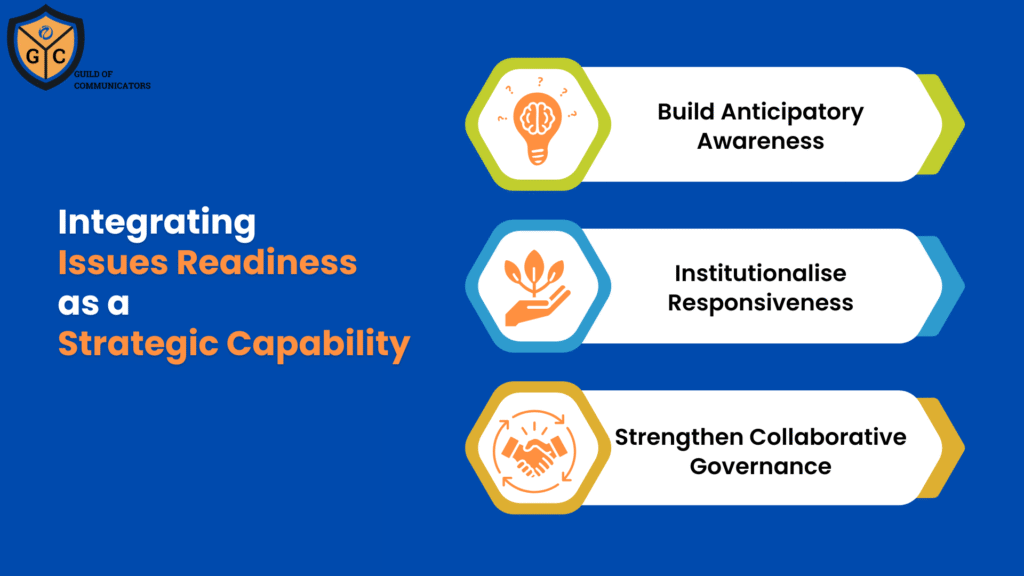
Three strategic principles can guide this shift: build anticipatory awareness, institutionalise responsiveness, and strengthen collaborative governance.
1. Build Anticipatory Awareness
The first step is mindset. Communicators need to recognise that potential issues form long before they are visible externally. Building anticipatory awareness means scanning for weak signals, mapping risk narratives, and translating them into communication implications.
Practical actions:
- Conduct monthly horizon scans across media, internal forums, and stakeholder feedback to identify early reputational signals.
- Run scenario workshops that test how small operational or employee issues might evolve into wider concerns.
- Integrate “what-if” questions into campaign planning — for example, what risks could arise if this message, partnership, or policy were challenged?
Anticipatory awareness ensures that communicators are not caught off guard and can guide internal teams with evidence-based foresight.
2. Institutionalise Responsiveness
When an issue surfaces, speed and alignment matter. Institutionalising responsiveness means embedding the capacity to act quickly without sacrificing accuracy or tone. It requires systems and practice, not improvisation.
Practical actions:
- Develop tiered response frameworks with pre-cleared thresholds and corresponding communication actions.
- Maintain a repository of pre-approved holding statements and Q&A templates to reduce decision paralysis.
- Rehearse crisis simulations twice a year with cross-functional teams to test coordination, message flow, and escalation paths.
Responsiveness becomes institutional when it is repeatable, predictable, and tested — not reliant on a few individuals reacting under pressure.
3. Strengthen Collaborative Governance
Effective issue management requires more than communication skill — it needs shared ownership across departments. Strengthening collaborative governance means aligning communication, legal, HR, and operations under clear roles and unified messaging.
Practical actions:
- Establish a standing “issues council”, advisory board or working group that meets regularly to review emerging risks and coordinate planning.
- Use shared dashboards or monitoring tools that provide real-time visibility to all key departments.
- After each incident or simulation, conduct structured debriefs and document lessons learned in an accessible knowledge base.
Collaboration removes silos, accelerates decision-making, and ensures the organisation speaks with one voice when it matters most.
The three principles of anticipatory awareness, institutional responsiveness, and collaborative governance form the foundation of this preparedness. Together, they shift communication from a reactive discipline into a forward-looking capability that strengthens trust inside and outside the organisation.
For communicators, the challenge ahead is not only to manage crises when they come but to design systems, relationships, and routines that keep the organisation ready before they appear. That readiness — built quietly, sustained deliberately — is what will define the communicators who lead effectively in 2026 and beyond.
*****
Ready to elevate your communications career? The Guild of Communicators is your essential hub for professional growth, offering a vibrant community and best-in-class resources.
- Connect Membership: Ideal for early-career communicators seeking a supportive peer network, over 300 foundational and intermediate courses, and monthly interactive group sessions.
- Elevate Membership: For ambitious professionals, this tier includes premium frameworks, immersive live online workshops, dedicated career coaching, and mentorship with senior industry leaders.
Discover your path to impact and accelerated career growth.
Join the Guild of Communicators today at www.gocommunicators.com.
(For students: If you’re a student, undergraduate or postgraduate, explore our special student referral programme to lock in your membership fee for the second year! Drop us an email to find out more)
——-
Subscribe to join over 1500+ communicators and brands getting value every Tuesday while reading A Communicator’s Perspective, our weekly newsletter.