
Project management in the communications field often feels like a balancing act performed during an earthquake. You are constantly managing competing deadlines, navigating complex stakeholder expectations, and trying to deliver excellence with limited resources. In this high-pressure environment, it is incredibly easy to get caught up in the chaos of the daily grind. The inbox fills up, the Slack notifications ping incessantly, and suddenly, your day is consumed by “urgent” tasks that may not actually move the needle.
For communicators, the instinct is often to try and do it all—to treat every request with the same level of importance and intensity. However, this approach is a fast track to burnout and mediocrity. The true challenge of project management is not about how much you can get done; it is about balancing priorities while staying focused on the bigger picture. It is about recognising that success does not come from clearing your to-do list, but from ensuring that the items on that list are the ones that truly drive value for your organisation.
The Trap of Treating Everything as Urgent
The fundamental challenge communicators face is the inability to distinguish between what is urgent and what is important. In a multifaceted campaign, there are hundreds of moving parts—copywriting, graphic design, media lists, stakeholder briefings, and event logistics. Not all components of a communication campaign carry the same weight, yet campaigns often falter because every aspect is treated equally.
When you treat a minor social media caption with the same level of strategic scrutiny as a flagship press release, you dilute your focus. The challenge lies in identifying where the true value of the campaign lies. Without a clear hierarchy of importance, you end up spreading your energy thinly across too many tasks. You become reactive rather than proactive, responding to whoever is shouting the loudest rather than focusing on the activities that will deliver the best results.
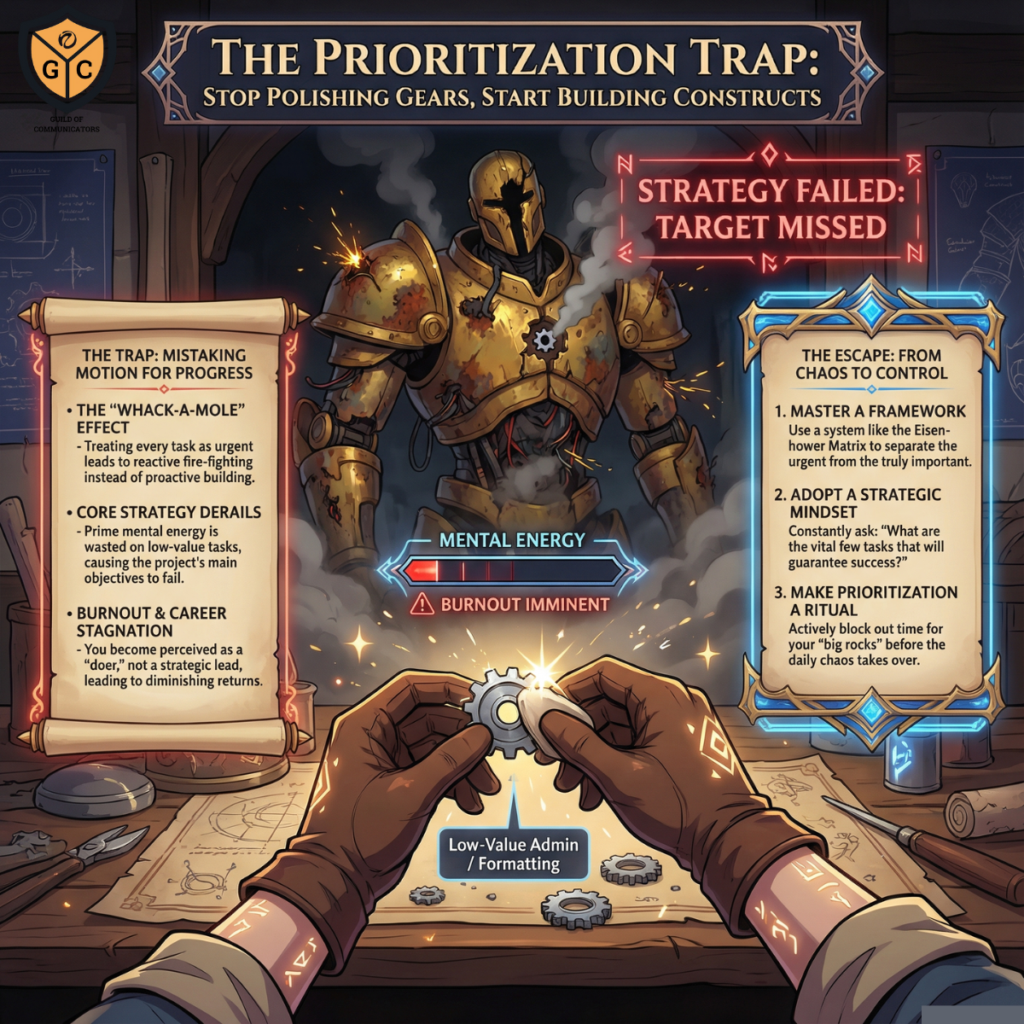
This lack of differentiation turns project management into a game of whack-a-mole, where you are constantly fighting fires instead of building the house.
Derailing Strategy for the Sake of Busyness
The consequences of failing to prioritise are severe, both for the project and for the communicator. Projects often derail when attention shifts to urgent tasks at the expense of strategic goals. When you spend your prime mental energy on low-value administrative tasks, you have little left for the high-level strategic thinking that actually drives success. This misalignment leads to wasted effort and missed opportunities. You might hit your deadline, but if the core message didn’t land because you were too busy formatting the report, the project has failed its primary objective.
On a personal level, this approach leads to professional burnout. The feeling of constantly running but never arriving is a symptom of poor prioritisation. You end up working long hours to compensate for the lack of focus, believing that “working harder” is the solution.
However, this just leads to diminishing returns. Ultimately, if you cannot effectively prioritise, stakeholders will lose confidence in your ability to lead. They will see you as a “doer” who needs to be managed, rather than a strategic lead who can be trusted to make the right calls on where to allocate resources.
Sharper Focus and Stronger Outcomes
Conversely, when you master the art of prioritisation, you transform the way you work. Working smarter, not harder, ensures consistent progress and stronger outcomes. By consciously deprioritising or delegating lower-value tasks, you free up the mental space required to execute the high-impact components of your campaign with excellence.
Prioritising the components that deliver the best results ensures your resources are focused on what matters most. Your campaigns achieve sharper, more impactful results because the critical elements—the key messages, the stakeholder engagement, the launch strategy—receive the attention they deserve.
Furthermore, this approach signals maturity to your leadership team. It demonstrates that you understand the business objectives well enough to know what is essential and what is noise. You become a guardian of the organisation’s resources, ensuring that time and budget are invested only in activities that generate a return.
Why We Prioritise the Wrong Tasks
To overcome the prioritisation trap, we must understand the psychology behind it. Human brains are wired to respond to urgency.
This is often referred to as the “Mere Urgency Effect,” where we choose to perform tasks with short completion windows over tasks with better long-term outcomes. An unread email feels like a threat that needs to be neutralised immediately, whereas drafting a strategic plan feels like a vague task that can wait.
Additionally, “busyness” serves as a psychological crutch. ticking off small, easy tasks provides a quick dopamine hit and a sense of accomplishment. It validates our work ethic (“Look how many emails I sent!”). Tackling a complex, high-value problem is cognitively taxing and often lacks that immediate feedback loop. We shy away from the discomfort of the important work and retreat into the comfort of the urgent work. Recognising this bias is the first step in overriding it and choosing to focus on value rather than volume.

Three Principles for Ruthless Prioritisation
Project management is not just about organisation; it is about decision-making. It is the courage to say “no” to the trivial many so you can say “yes” to the vital few. By understanding the difference between urgency and importance, and by implementing rigid frameworks to protect your focus, you can navigate the chaos of communication projects without losing your way.
To move from chaos to control, you need to adopt a structured approach to decision-making.
1. Master Prioritisation Frameworks. You cannot rely on your gut feeling to decide what to do next; you need a system. Start by mastering prioritisation frameworks like the Eisenhower Matrix or a weekly project review. The Eisenhower Matrix forces you to categorise tasks into four quadrants based on urgency and importance. It reveals the uncomfortable truth that much of your day is likely spent in the “Urgent but Not Important” quadrant. By using this tool daily, you can consciously align your daily actions with overarching objectives, ensuring that you are tackling the “Important” tasks before the “Urgent” ones take over.
2. Adopt a Strategic Mindset. Stop looking at your to-do list as a flat list of tasks. Adopt a strategic mindset and assess each element of the campaign against your objectives and audience needs. Ask yourself: “If I could only do three things on this list today to make this project succeed, what would they be?” This question forces you to identify the critical path. Focus on the components that provide the highest output or align most closely with the project’s value. If a task does not directly contribute to the core objective, question whether it needs to be done at all.
3. Prioritise with Intent. Make prioritisation an active, daily ritual. At the start of every week, review your project plan and identify the “big rocks”—the major milestones that must be moved. Block out time for deep work on these items before you open your email. When new tasks land on your desk, do not just add them to the pile. Evaluate them immediately against your strategic goals. When you prioritise with intent, your campaigns will achieve sharper, more impactful results. You stop being a passenger in your own project and start being the driver.
Success is not a result of how many hours you work, but of how well you direct your energy. Master prioritisation, and you will not only avoid burnout but also deliver the kind of high-level impact that defines a successful career.
To help you navigate the journey, I have designed an exclusive infographic. Complete the form below to join A Communicator’s Perspective—our weekly newsletter for growth-minded professionals—and receive this essential infographic directly to your inbox.