A strong communication plan is only truly effective when it translates directly into real-world results. For many communicators, the natural inclination is to begin with a creative concept that feels inspired or a visual execution that is aesthetically pleasing. However, our world is filled with campaigns that appeared flawless on paper but failed to move the needle on actual business objectives. To succeed, the communicator must shift their focus from the “pretty idea” to the fixed outcome (or the impact of the action).
This shift requires a fundamental change in how we approach the “brief”. Instead of asking what a campaign should look like, we must first ask what it is intended to achieve. When execution focuses on aesthetics instead of impact, the results become secondary to the concept itself.
By defining success at the very beginning of the process, every subsequent step becomes intentional and aligned with the end goal. This intentionality is what separates a creative exercise from a strategic communication initiative.
With the integration of AI and automation tools into the industry, the role of the communicator is evolving from a creating content to orchestrating outputs and outcomes. AI can assist in mapping out these outcomes and identifying the variables that drive success, but the human practitioner must provide the strategic direction.
The Disconnect Between Execution and Impact
The primary challenge for the communicator is the common assumption that a well-executed campaign—one with polished visuals, sharp copy, and seamless delivery—will inherently be effective.
Communication is not about perfection; it is about influence. A campaign fails if it does not address the audience’s specific needs, challenges, or motivations. When practitioners prioritise the “how” of execution over the “why” of influence, they risk creating content that is ignored by the very people it is meant to reach.
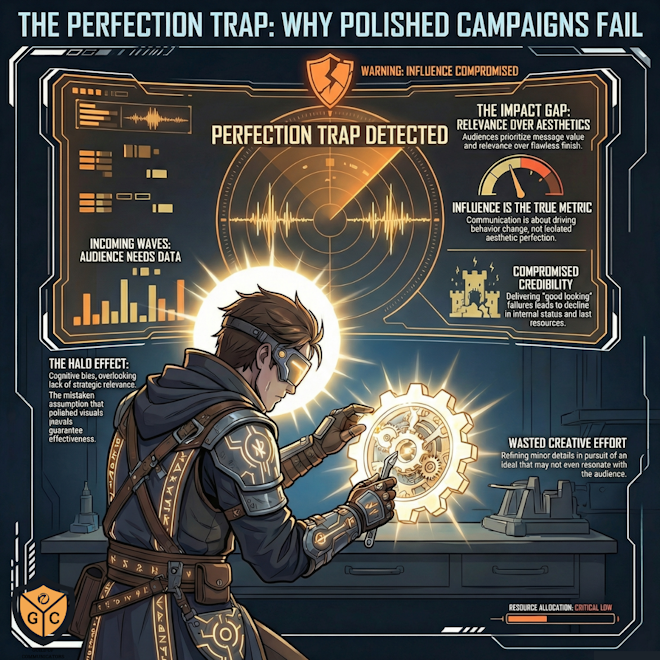
This problem is often exacerbated by the “perfection trap,” where communicators spend excessive time refining minor details of a project in the pursuit of an ideal that may not even resonate with the audience. This focus on a perfect final product often leads to delays and missed opportunities. Audiences typically care more about the value delivered and the relevance of the message than they do about a flawless finish. When the pursuit of perfection becomes a barrier to progress, the communicator loses the ability to execute consistently with quality.
If the campaign looks great but does not lead to engagement, behaviour change, or action, it has effectively failed to meet its strategic purpose. This lack of alignment makes it difficult for stakeholders to see the value of the communication function, leading to a perception that PR and marketing are discretionary costs rather than essential drivers of business outcomes.
The Organisational Consequences of Misaligned Strategy
In the medium term, consistently delivering campaigns that “look good” but do not deliver results leads to a decline in internal credibility. Stakeholders and senior management look to communicators for stability and the ability to drive measurable change; when this is not provided, the communicator is often excluded from high-level strategic discussions.
The long-term consequences are even more severe. Without a clear link between communication activities and business results, securing the necessary resources and budget for future projects becomes increasingly difficult.
In a matrix organisation, visibility of impact is key to gaining buy-in. If key stakeholders cannot recognise the tangible benefits of your work, they are unlikely to support your initiatives or advocate for your team. This can stall career progression, as they are seen as tactical executors rather than strategic partners.
Furthermore, an over-reliance on “pretty ideas” leads to wasted effort and resource depletion. If you are not working backward from a defined outcome, you are likely engaging in activities that do not contribute to the final goal. This inefficiency prevents the communicator from scaling their efforts or integrating new technologies, such as AI and automation, which require a clear framework to be effective. Eventually, the practitioner becomes reactive, struggling to manage short-term demands while losing sight of the broader strategy.
The Benefits of a Result-Oriented Approach
By adopting an outcome-first mindset, practitioners can transform their role and the impact of their work. This approach ensures that every tactical decision is tied directly to a measurable goal, preventing wasted effort and ensuring that the execution remains purposeful. When you define success first, you create a roadmap that makes the desired outcome more likely to occur. This clarity allows for more precise execution and a more efficient use of both human and technological resources.
Communicators who master this alignment become invaluable to their organisations. They can demonstrate how their work directly contributes to business objectives, which in turn secures the resources and internal support they need. This strategic advantage also allows the communicator to stay calm and proactive when project variables change mid-way. Because they are focused on the final outcome rather than a rigid process, they can adjust their tactics in real-time based on data and audience feedback without losing sight of the ultimate goal.
Focusing on “well-done” over “perfect” ensures that the message actually reaches the audience and creates an impact. This consistency builds momentum and allows the communicator to learn from each campaign, refining their approach for future success.
The Psychology of the “Pretty Idea”
We often assume that a polished, aesthetically pleasing campaign will inherently be more effective because humans are naturally visual creatures. This preference for what we can see and measure easily—like a beautiful graphic or a clever headline—can lead us to favour aesthetics over the more abstract but critical elements of relevance and audience resonance.
The brain naturally seeks patterns and direction, which is why a concrete target is so helpful for alignment. However, without a clear, outcome-driven target, the brain defaults to the most immediate and tangible task: creating something that “looks right”. This is often a defence mechanism against the uncertainty of a project. Communicators may feel that if the execution is perfect, they have fulfilled their responsibility, even if the strategic goal remains unachieved.
Additionally, the “Halo Effect” can lead practitioners to believe that because one part of a campaign is excellent (e.g., the design), the entire campaign will be successful. This cognitive bias ignores the reality that audiences prioritise relevance over aesthetics. People remember how a message makes them feel and how well it addresses their needs, not the technical perfection of the execution.

Practical Steps to Align Creative Execution with Business Objectives
To ensure your creative output translates into tangible results, communicators should adopt a structured framework grounded in strategic principles. By integrating these steps into your daily workflow, you can move from a tactical mindset to a strategic one.
- Deploy Reverse Engineering to Define Intentional Milestones: Start by setting a strict, quantifiable goal—for example, “increase lead generation by 15 percent in the next quarter”—rather than a vague objective like “boost brand awareness”. Once the outcome is clear, work backward to identify every key milestone, decision point, and dependency required to reach it. Use automated project management tools to track these variables and ensure that every piece of content created serves a specific milestone on the path to the final goal.
- Apply Audience-First Messaging and Emotional Resonance: Influence is driven by clarity and relevance rather than cleverness. Use AI sentiment analysis and social listening tools to understand the real needs and motivations of your target audience. Ensure that your messaging addresses these specific challenges in a way that is easy to absorb. Before finalising any creative asset, ask whether it serves the audience’s interests or merely the creative team’s aesthetic preferences.
- Implement Fixed Outcome Planning with Tactical Flexibility: Lock in your non-negotiable results but remain adaptable in your approach. Establish regular data-driven check-ins to evaluate whether your current tactics are delivering the expected progress toward the benchmark. If a specific channel or creative format is not producing the desired engagement, use AI to rapidly iterate on new versions or pivot your distribution strategy. This ensures you remain focused on the outcome while responding to real-time feedback.
Strategic communication is about marrying creative excellence with measurable impact. By moving away from the pursuit of a “perfect” idea and embracing a result-oriented framework, you can ensure that your work consistently delivers value to your organisation. Focus on what is essential, remain adaptable, and always prioritise the result over the process.
The Guild of Communicators is merging with and integrating into the We Are Brand Utility organisation: read more in our article here. If you are interested in the topics of Narrative Intelligence, Digital Subject Stewardship, Narrative Autonomy and Authoritative Source, subscribe to our newsletter through this form: