
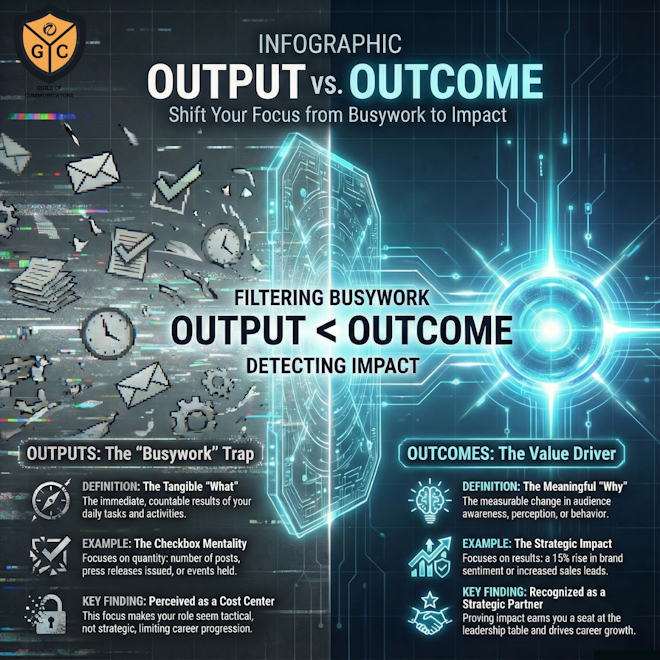
As a communicator, you create things. You write press releases, publish social media posts, organise events, and distribute newsletters. These are your outputs: the tangible, immediate, and countable results of your daily efforts. They are essential because they represent the work being done.
However, they are not the reason your role exists.
The true purpose of your work is to create outcomes: the meaningful, longer-term effects your outputs have on your audience and your organisation. Outcomes are the changes in awareness, perception, or behaviour that drive business results. For an early-career communicator, the most critical shift you can make is to move your focus from the activity you produce to the impact you create.
This distinction is the difference between being seen as busy and being recognised as essential.
The Problem of Confusing Activity with Progress
It is incredibly easy to fall into the trap of confusing activity with progress. Your performance is often evaluated based on what can be easily counted: the number of media mentions secured, the volume of content published, or the percentage increase in followers.
This creates a powerful incentive to prioritise quantity over quality, leading to a ‘checkbox mentality’ where the goal is simply to complete a list of tasks. The professional satisfaction comes from ‘doing’—from having a full calendar and a long list of completed deliverables to report at the end of the week.
This focus on outputs feels productive. It provides a clear, linear measure of effort and accomplishment. However, it completely sidesteps the more difficult and important question: “Did any of this work actually matter?”
When your primary goal is to send four newsletters a month, you stop asking if those newsletters are changing anyone’s perception of the brand.
When you are tasked with securing ten media clips, you stop scrutinising whether those clips reached the right audience with the right message.
This relentless focus on the ‘what’ of your work obscures the ‘why’, creating a cycle of activity that may have little to no strategic impact on the organisation’s goals.
The Consequences of Failing to Demonstrate True Value
The long-term consequences of an output-focused mindset are profound and career-limiting. When your contribution is measured solely by the volume of your activity, you position yourself and your function as a cost centre, not a value driver.
You are the person who ‘does the social media’ or ‘writes the press releases’.
Your work is perceived as a series of operational expenses rather than strategic investments. This makes your budget one of the first to be cut during difficult times and makes it nearly impossible to argue for additional resources, as you cannot demonstrate a clear return on investment.
Professionally, this perception prevents you from earning a seat at the strategic table. Leaders in the organisation are concerned with outcomes—market share, customer loyalty, sales growth, and brand reputation. If you can only report on your outputs (“we published 30 posts on LinkedIn this month”), you are not speaking their language.
Your work is seen as tactical ‘busywork’, disconnected from the core objectives of the business. This perception will hold you back, preventing you from being included in important strategic conversations and limiting your career progression to that of a service provider rather than a trusted strategic advisor.
The Rewards of Connecting Outcomes to Business Results
Conversely, when you intentionally shift your focus to defining, driving, and measuring outcomes, your professional value skyrockets. By connecting your communication efforts directly to meaningful business results, you change the conversation entirely. You are no longer just reporting on your activities; you are demonstrating your impact.
Instead of saying, “We issued five press releases,” you can say, “Our media relations campaign led to a 15% increase in positive brand sentiment among our target audience.”
This simple shift reframes your function from a tactical necessity to a strategic advantage. This ability to prove your value earns you credibility and respect within the organisation. You become a strategic partner whose advice is sought during the planning stages, not just an executor who is handed a completed brief. Your work is seen as an essential driver of success, making it easier to secure budgets, gain stakeholder buy-in, and lead more ambitious initiatives.
For your career, this is the path to leadership. An outcome-driven communicator is someone who can be trusted to manage resources effectively and deliver measurable results, demonstrating the business acumen required for senior roles. You move beyond being a good communicator to becoming an effective business leader.

The Underlying Reason We Avoid Measuring What Matters
To make this shift, it is crucial to understand the psychological pull of outputs.
Our brains are wired to prefer the satisfaction of completing concrete, tangible tasks. Outputs are easy to count and provide an immediate sense of accomplishment. Finishing a blog post, scheduling a week’s worth of social media, or sending a newsletter gives you a small hit of dopamine. You can physically see the result of your labour, and it feels good. This creates a powerful feedback loop that encourages you to focus on producing more ‘things’.
Outcomes, on the other hand, are often abstract, harder to measure, and take much longer to materialise. Measuring a change in public perception is far more complex than counting likes or shares. Proving that your campaign contributed to an increase in sales requires sophisticated analysis and collaboration with other departments. Because the reward is delayed and the process is ambiguous, focusing on outcomes is psychologically less appealing than the instant gratification of completing a simple task.
This comfort with the tangible and measurable, combined with a fear of the complex and uncertain, is the underlying reason we so often avoid the difficult but essential work of measuring what truly matters.
The Method for Shifting Your Focus from Outputs to Outcomes
Adopting an outcome-focused mindset is a conscious decision to trade the easy satisfaction of activity for the enduring value of impact. It requires you to be more disciplined in your planning, more rigorous in your execution, and more accountable for your results.
This approach transforms your role from that of a content producer into that of a strategic architect, capable of building and shaping the reputation and success of your organisation.
Shifting your practice from being output-driven to outcome-focused requires a deliberate change in your process. It starts not at the end of a campaign, but at the very beginning. You can instil this discipline in your work by following three strategic principles.
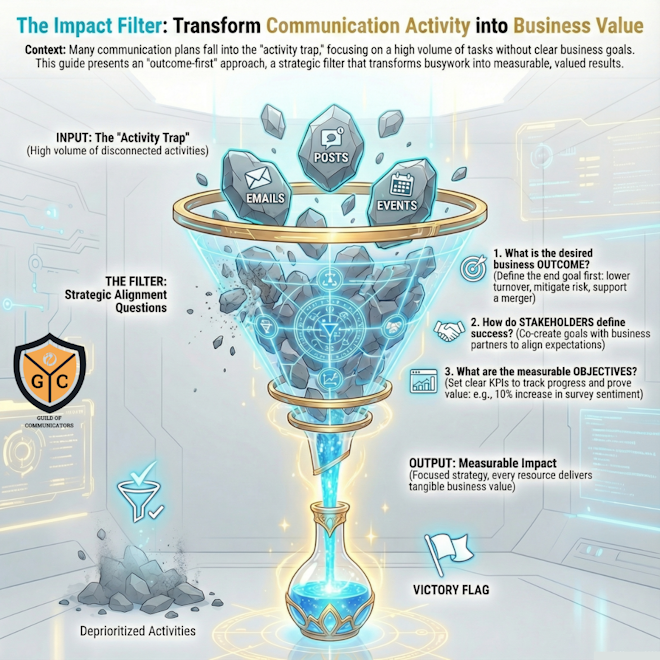
- Begin with Clear Outcome Goals. Before you plan any tactic or create any content, you must first define what success looks like in terms of outcomes. Start by asking, “What do we want our audience to think, feel, or do as a result of this communication?” Your goals should be specific and measurable. Instead of a goal like “promote the new product,” an outcome-based goal would be “increase awareness of the new product’s key benefit by 25% among our target demographic within three months.” This forces you to think about impact from the outset.
- Align All Strategies to Drive Outcomes. Once you have a clear outcome goal, every tactic and message you develop must be deliberately designed to contribute to it. Use your outcome as a filter for every decision. Does this social media campaign directly support our goal of changing perception? Will this press release reach the audience we need to influence? If a proposed activity, no matter how creative or interesting, does not clearly help you achieve your defined outcome, you should question its value or discard it. This ensures that all your efforts are purposeful and efficient.
- Measure What Matters. To prove your value, you must move beyond vanity metrics (likes, impressions, follower counts) and focus on tracking indicators that reflect genuine impact. These could include metrics like message resonance (is the audience repeating your key messages?), audience sentiment (is the tone of conversation about your brand positive?), or changes in behaviour (are more people visiting your website or downloading a resource after seeing your campaign?). Reporting on these deeper metrics is how you demonstrate the true return on investment of your communication efforts.
This is not just about better reporting; it is about fundamentally changing the way you approach your work and how your organisation perceives your contribution. By consistently demonstrating how your efforts connect to the bottom line, you are not just doing your job better—you are building a resilient, influential, and indispensable career. Make this shift your priority, and you will move from being a cost on a spreadsheet to a key driver of business value.
To help you navigate the journey from fragmented messaging to strategic impact, I have designed an exclusive infographic. Complete the form below to join A Communicator’s Perspective—our weekly newsletter for growth-minded professionals—and receive this essential infographic directly to your inbox.