In project management, the most dangerous risks are often invisible until it is too late. You can have a perfect timeline, a robust budget, and a talented team, yet still deliver a project that is deemed a failure by your leadership.
How does this happen?
It happens when there is a fundamental disconnect regarding what “success” actually looks like.
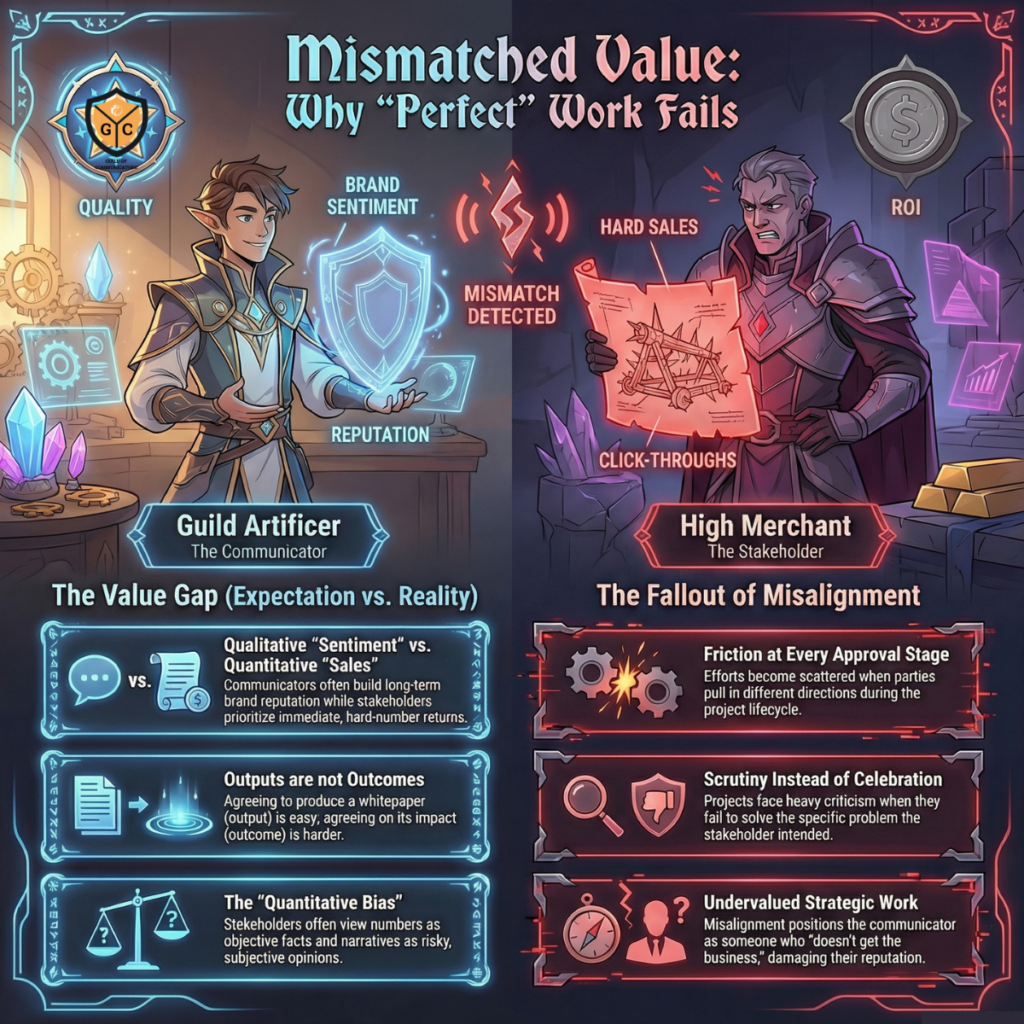
Confusion often arises when stakeholders and communicators have different definitions of value. You might be celebrating a rise in brand sentiment, while your stakeholder is asking why sales leads haven’t doubled.
This misalignment is the silent killer of projects. For communicators, the ability to align stakeholders not just on the deliverables (what you will do) but on the value (what it means) is a critical skill that prevents projects from collapsing under the weight of mismatched expectations.
Bridging the Gap in Expectations
The core challenge lies in ensuring all stakeholders agree on both the deliverables (outputs) and the impact they aim to achieve (outcomes). It is relatively easy to agree on a deliverable: “We will produce a whitepaper.”
It is much harder to agree on the expected impact of that whitepaper. Does success mean 500 downloads? Or does it mean five meetings booked with C-suite prospects?
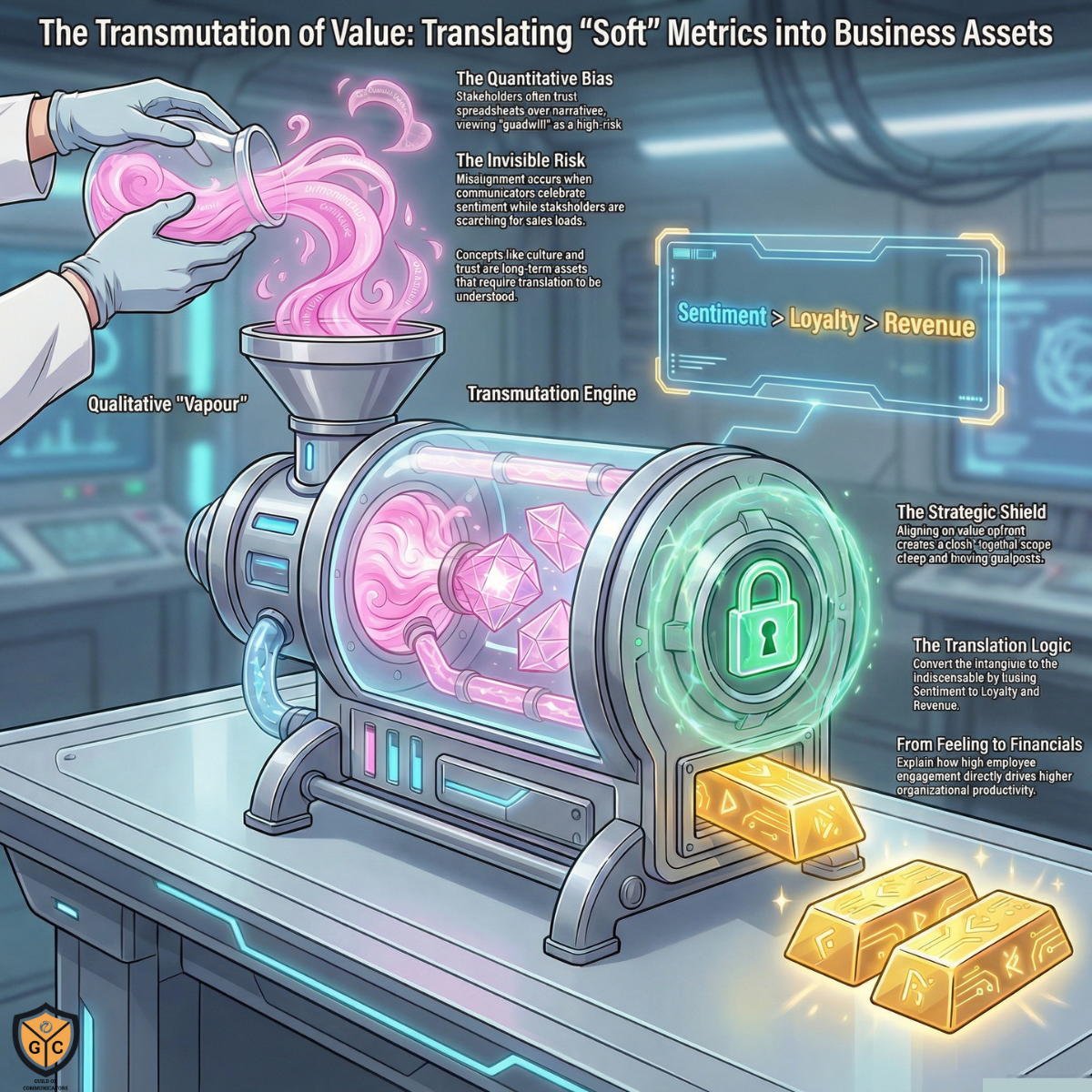
This challenge is compounded when dealing with qualitative value. Quantifying a campaign’s value is often straightforward when dealing with sales data but demonstrating its qualitative impact, for example, reputation building or audience trust can be challenging.
Stakeholders, particularly those in finance or operations, often struggle to see the bigger picture. They operate in a world of hard numbers and immediate returns, whereas communicators often deal in long-term asset building. Bridging this gap requires you to rationalise qualitative value in a way that resonates with their worldview.
Friction, Confusion, and Undervalued Work
When expectations are misaligned, the consequences ripple through the entire project lifecycle. Without clarity, efforts can become scattered and less effective. You might spend weeks optimising a campaign for engagement, only to find out the stakeholder was solely interested in click-through rates. This creates friction at every approval stage, as you are essentially pulling in different directions.
Ultimately, this leads to confusion about what success looks like.
When the final report is presented, instead of celebration, you face scrutiny. Your hard work is undervalued because it didn’t solve the problem the stakeholder thought you were solving.
This damages your professional reputation, positioning you as someone who “doesn’t get the business,” rather than a strategic partner who drives growth.
Shared Vision and Strategic Trust
The benefits of achieving early alignment are transformative. Clear communication ensures everyone is working towards the same goals. When you agree upfront that the goal is “reputation enhancement” rather than “immediate sales,” you buy yourself the freedom to execute the right strategy without constant second-guessing.
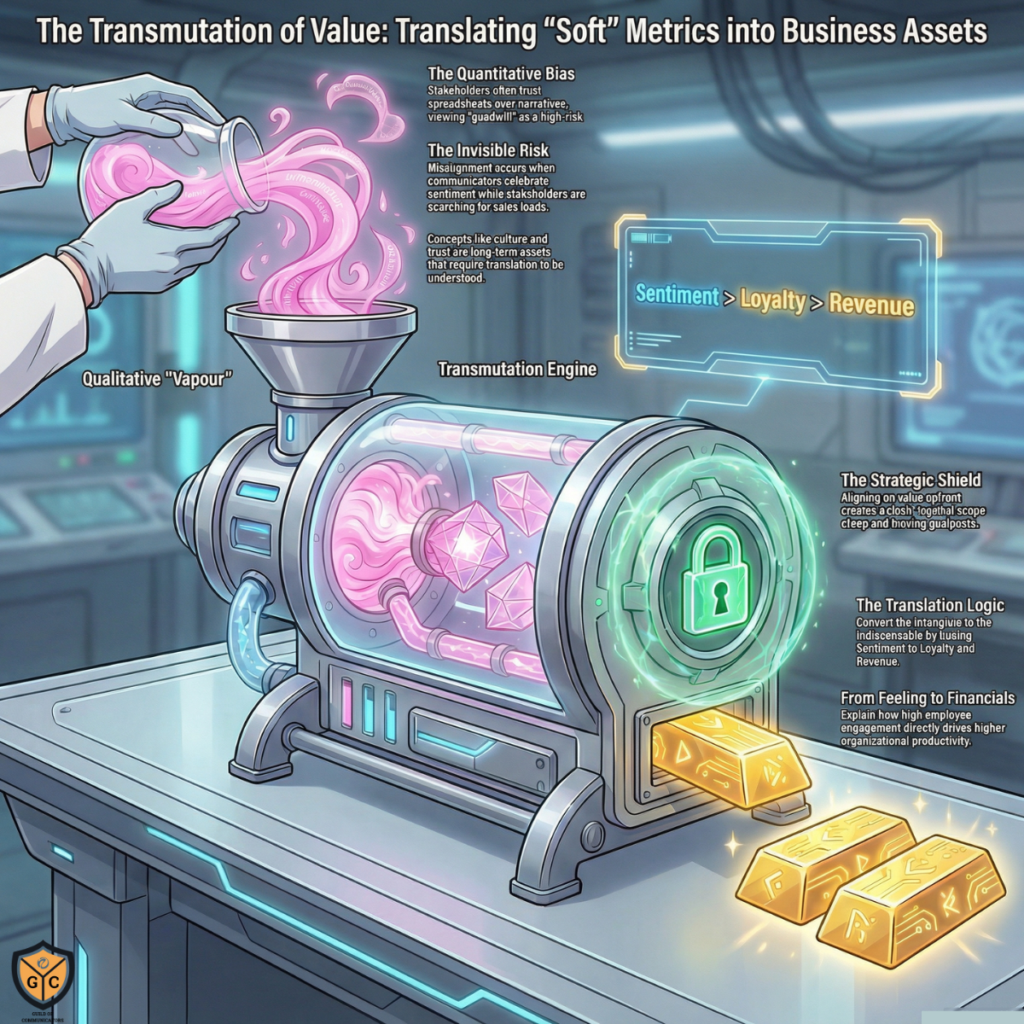
Furthermore, when you successfully translate qualitative value into relatable terms, it becomes easier for stakeholders to see its importance. They begin to understand that “brand sentiment” is not a vanity metric, but a leading indicator of future customer loyalty. This builds strategic trust. Stakeholders learn to rely on your judgment not just for how to say things, but for what should be done to achieve business objectives.
Why Stakeholders Trust Numbers Over Narratives
To solve this, we must understand the “Quantitative Bias” of the corporate world.
Stakeholders often view numbers as objective facts and narratives as subjective opinions. Intangible outcomes—like trust or culture—underpin long-term success, yet they require thoughtful explanation to highlight their significance.
Stakeholders are often risk-averse. A spreadsheet feels safe; a story about “goodwill” feels risky. They need help seeing the causal link between “soft” metrics and “hard” business goals. They aren’t trying to be difficult; they are trying to be responsible. Your role is to provide the psychological safety they need by demonstrating that your qualitative strategies have a concrete logic behind them.
Three Principles for Strategic Alignment
Alignment is not a one-time meeting; it is a continuous process of translation and education. By taking the responsibility to define value clearly—both tangible and intangible—you ensure that your stakeholders are not just passengers on your project, but partners in its success.
To align stakeholders and protect your project’s success, apply these three principles.
1. Collaborate Early to Define ‘Success’. Do not wait for the brief to land on your desk; shape it. Collaborate with stakeholders early. Facilitate a session where you explicitly discuss what they expect to see (outputs) and the results they hope to achieve (outcomes). Be specific. Align on whether success means delivering ten case studies or increasing customer inquiries by 25%. Write this down. This agreed definition of success becomes your shield against scope creep and moving goalposts later in the project.
2. Frame Qualitative Value in Business Terms. Stop speaking “comms” and start speaking “business.” Frame qualitative value in terms of its contribution to business goals. Do not just report “increased brand sentiment.” Instead, link enhanced brand sentiment to future customer loyalty. Explain that high employee engagement leads to higher productivity. When you draw the line between the feeling and the financial result, you convert the intangible into the indispensable.
3. Evidence Your Claims. If you are going to argue for the value of the intangible, bring proof. Use case studies, testimonials, or trend analyses to back up your claims. Show them what happened when a competitor ignored reputation, or how a similar campaign led to a long-term uptick in market share. Evidence bridges the gap between your intuition and their need for certainty.
When you align expectations effectively, you do more than just deliver a project; you deliver a shared victory.
The Guild of Communicators is integrating with We are Brand Utility. Read our announcement at this link – https://www.gocommunicators.com/the-guild-of-communicators-joins-we-are-brand-utility.