When it comes to project management in the communication function/field, it is easy to mistake motion for progress. We often judge the success of a campaign by the volume of work produced: the number of press releases distributed, the frequency of social media posts, or the number of events hosted.
These are outputs—the tangible products of our labour. While they are necessary, they are not the goal.
However, a project can generate a high volume of activity but still fail to move the needle for the organisation.
The true measure of success lies not in what you produce, but in the impact those efforts have on your audience.
For communicators, the critical shift is moving from counting outputs to measuring outcomes. This distinction is the difference between simply being busy and being effective.
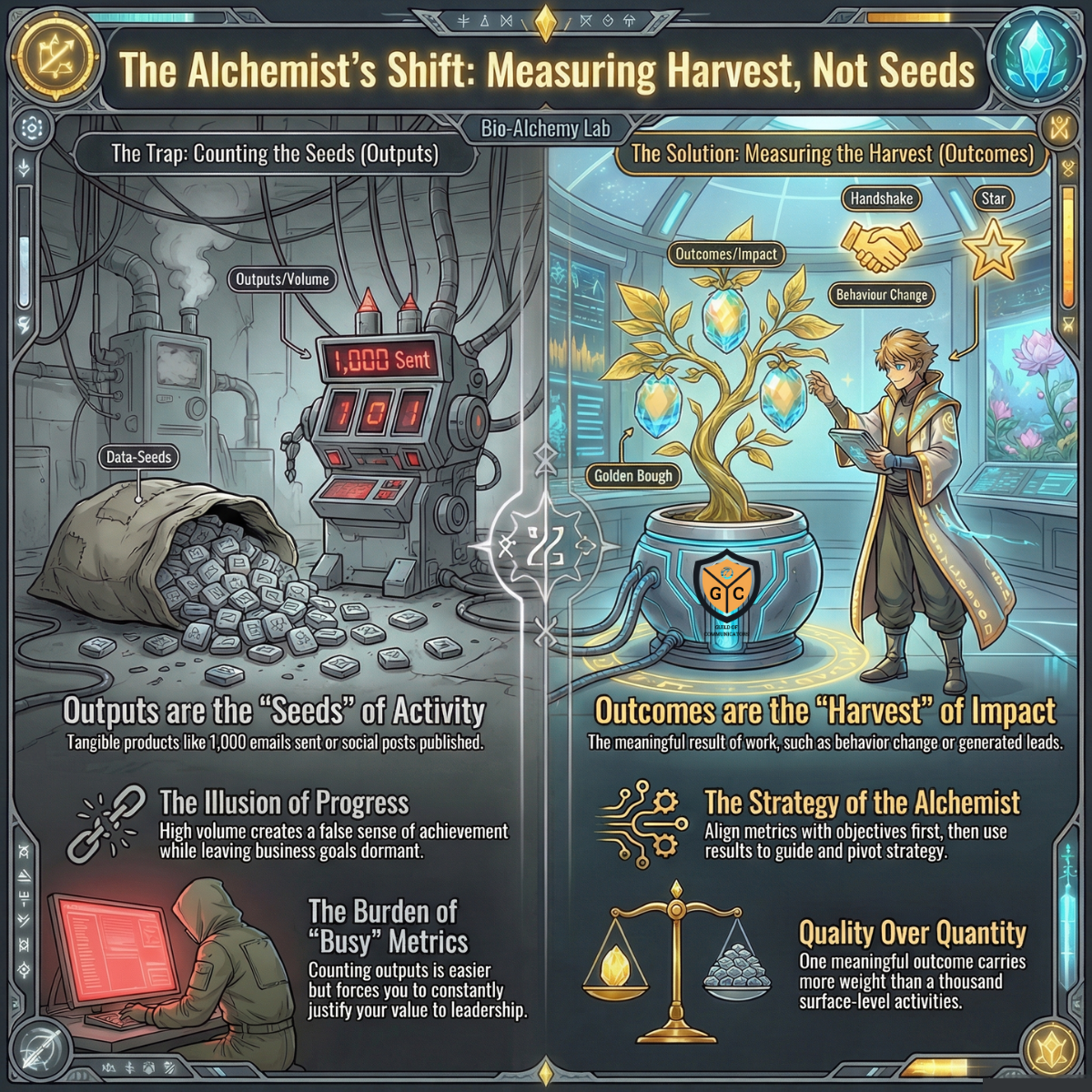
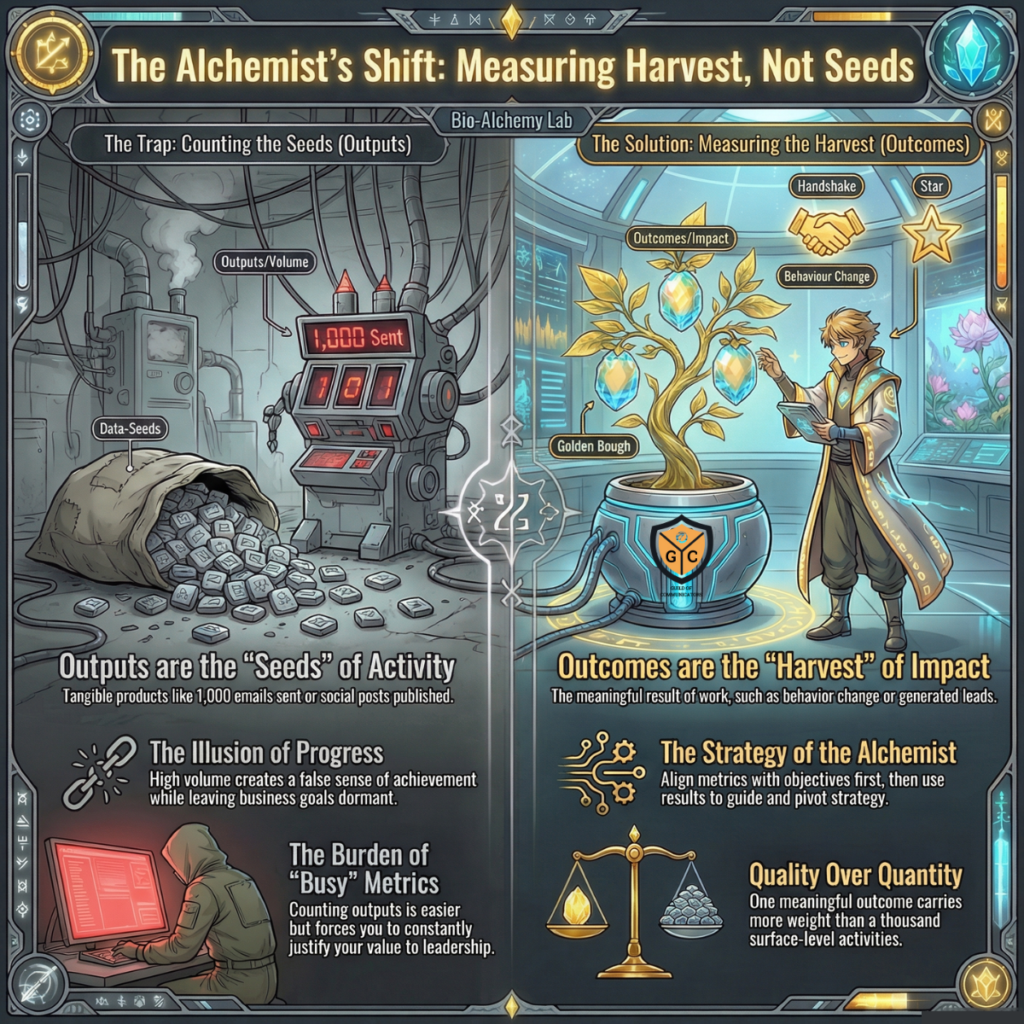
The Illusion of Progress
The primary challenge lies in understanding the fundamental difference between outputs and outcomes and then creating metrics that are actually actionable.
Outputs are what you produce (e.g., “We sent 100 emails”); outcomes reflect the impact of those efforts (e.g., “We generated 20 qualified leads”).
Many communicators struggle because they rely on metrics that are easy to track rather than metrics that provide insight. It is straightforward to report on how many influencers were contacted, but much harder to determine if that outreach changed brand sentiment.
Without clear metrics, it is impossible to measure a project’s success—or know if you are on the right track. This reliance on surface-level data creates an illusion of progress, where the team feels productive because they are hitting deadlines, even if those deadlines are not driving the business forward.

A False Sense of Achievement
Focusing solely on outputs leads to a false sense of achievement. You might look at a completed dashboard full of green ticks and believe the project was a triumph, only to face difficult questions from leadership about what that activity achieved.
This output-centric approach creates an additional burden on the communicator.
When you cannot point to tangible results like behaviour change or lead conversion, you are constantly forced to explain and justify how the campaign is contributing value to the organisation.
Over time, this erodes trust. Stakeholders begin to view the communication function as a cost centre that generates “noise,” rather than a strategic partner that generates results. Furthermore, without outcome-based data, you are flying blind, unable to optimise your strategy because you are measuring the wrong things.
Clarity and Better Decision Making
When you shift your focus to outcomes, the fog lifts. Metrics should not only reflect results but also guide decisions throughout the campaign lifecycle. By aligning your metrics with your true objectives, every step of the project becomes clearer.
For instance, instead of tracking “media volume,” focusing on “number of product queries received” gives you real-time feedback on whether your message is resonating.
This allows you to pivot quickly – stopping activities that don’t work and doubling down on those that do.
Outcome-based measurement transforms reporting from a defensive exercise (“Here is what we did”) into a strategic tool (“Here is what we achieved”). It empowers you to have value-based conversations with stakeholders, demonstrating exactly how your work supports their business goals.
Why We Prefer to Count Things
Why is this shift so difficult?
Psychologically, humans have a bias towards “Cognitive Ease.” Outputs are concrete, controllable, and easy to count. We know exactly how to write a press release, and once it is sent, the task is done. This provides a sense of closure and control.
Outcomes, however, are often external and influenced by factors outside our direct control. We cannot force someone to buy a product or change their mind; we can only influence them. This introduces uncertainty and vulnerability. We fear being held accountable for results we cannot 100% control, so we retreat to the safety of the metrics we can control. Overcoming this requires the courage to embrace accountability and the confidence to trust your strategy.
Three Principles for Meaningful Measurement
Defining success is arguably the most important task of any project manager. By refusing to settle for vanity metrics and insisting on measuring meaningful outcomes, you do more than just prove your worth—you improve your work.
To escape the output trap, you need to rebuild your measurement framework using these three principles.
1. Align Metrics with Objectives First. Never start a project by asking, “What can we measure?” Start by asking, “What does success look like?” If the objective is to increase brand trust, counting press clippings is irrelevant. Start by aligning metrics with your objectives. Define the goal, break it down into measurable steps, and choose metrics that provide real insight. If you cannot draw a straight line between the metric and the business goal, discard it.
2. Focus on Behaviour, Not Just Volume. Shift your focus from what you did to what the audience did. Instead of measuring “how many press releases were sent,” evaluate “how many actions were taken as a result.” Did they visit the website? Did they sign up for the webinar? Did they share the content with a positive sentiment? These behavioural indicators are the true currency of impact.
3. Use Metrics to Guide, Not Just Report. Do not wait until the end of the project to look at the numbers. Use your outcome metrics as a compass. If your goal is lead generation and your mid-campaign report shows high traffic but low conversion, you know you have a content problem, not a distribution problem. When your metrics align with your goals, they become a diagnostic tool that helps you steer the project toward success.
Stop counting the seeds you plant and instead start measuring the harvest you gather. Yes, it will take time to see the harvest.
No, we do not get to ‘go away’ and wait for results to happen. Results require proactive participation in the process. During the interim period, it is incumbent upon the communicator to continue updating stakeholders and maintaining relationships as well as influencing outcomes.
This shift in mindset is what separates the busy communicator from the effective strategist.
To help you navigate the journey, I have designed an exclusive infographic. Complete the form below to join A Communicator’s Perspective—our weekly newsletter for growth-minded professionals—and receive this essential infographic directly to your inbox.