
Initial strategic plans frequently encounter unforeseen disruptions once implementation begins. Unexpected shifts in data, changing priorities, and external market factors can quickly disrupt even the most well-researched strategy and plan.
While the plan provides a necessary direction, the actual success of a campaign is driven by the communicator’s ability to adapt and execute effectively in real-time.
The instinct is often to cling to the original document as a source of safety. However, true strategic stability does not come from ignoring environmental changes, but from the ability to process new information and adjust without losing sight of the overall objective. Adaptability is not merely a soft skill; it is a strategic advantage that allows a communicator to remain proactive rather than reactive in a volatile business environment.
As AI and automation tools provide faster access to real-time data, the window for adjustment has narrowed. Communicators must be prepared to refine their tactics based on audience feedback and shifting performance indicators rather than relying on outdated assumptions.
Mastering the balance between a fixed end goal and flexible execution is what defines a high-performing communications function.
The Challenge of Shifting Variables and Metrics
Communicators are often expected to maintain project stability even when variables change mid-way through a campaign. This expectation creates a significant challenge: how to manage uncertainty without hesitation while still delivering on promised outcomes. When internal leadership priorities change or external tracking tools are updated, it can feel as though the very foundation of the project is being undermined.
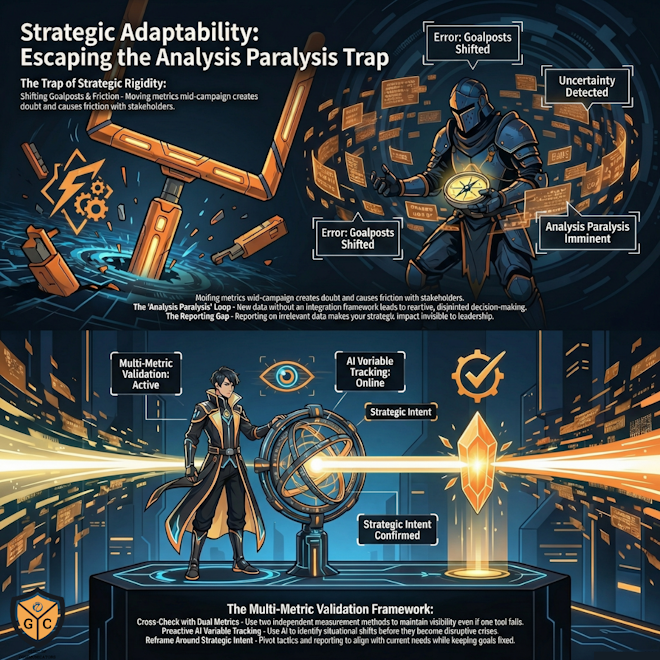
One of the most disruptive challenges occurs when the “goalposts” move—specifically when measurement frameworks or success metrics shift during an active campaign. This can create immediate doubt regarding the campaign’s effectiveness and relevance. If a communicator is unprepared for these shifts, they may find themselves defending a strategy that no longer aligns with the organisation’s immediate needs, leading to friction with stakeholders.
Furthermore, the introduction of new data mid-campaign can cause “analysis paralysis” if there is no framework for integration. Without a structured way to assess which variables truly matter, the communicator risks making reactive decisions that move the campaign away from its strategic intent. This creates a disjointed execution where tactics are changed for the sake of change, rather than to improve the outcome.
The Risks of Strategic Rigidity
A failure to adapt to changing circumstances has clear negative consequences for the communicator’s standing within an organisation. In the medium term, team members who rigidly follow a plan that is no longer aligned with reality are seen as out of touch with business needs. This lack of situational awareness reduces the level of trust stakeholders place in the communication team, making them less likely to look to the practitioner for guidance during future periods of uncertainty.
Long-term, the inability to manage shifting metrics leads to a reporting gap. If the way success is measured changes, but the communicator continues to report on original, now-irrelevant data, the campaign’s impact remains invisible to leadership. This can lead to the withdrawal of resources or the premature termination of projects that may have been delivering meaningful outcomes but failed to meet the new reporting requirements.
Moreover, staying reactive prevents the communicator from building a proactive reputation. Constant “firefighting” in response to unexpected shifts prevents the development of long-term strategic depth. If every variable change results in panic or a loss of direction, the communicator will struggle to advance into senior roles where managing complexity and volatility is a core requirement of the position.
The Advantage of Strategic Fluidity
When a communicator learns to embrace adaptability, they gain a significant strategic advantage within their organisation. By focusing on outcomes rather than rigid tactics, the communicator can navigate chaos while keeping the end goal in sight. This approach allows for the processing of new information without panic, ensuring that decisions remain informed and confidence driven.
A major benefit of this mindset is the ability to maintain campaign relevance regardless of how success is measured. When the practitioner understands that measurement is a tool to capture impact, not to redefine it, they can adjust their reporting to reflect new metrics without losing the core value of the campaign. This transparency ensures that the work remains visible and valued by stakeholders even in a matrix organisation where priorities are constantly shifting.
An adaptable approach allows for the effective use of AI and automation to track key variables and build contingency plans. This technical integration makes execution smoother and more impactful, as the team can pivot with purpose based on data rather than assumptions. Overcoming the challenge of change transforms the communicator into a stabilising force that leadership can rely on during complex transitions.
The Psychology of the Need for Stability
The difficulty in managing shifting variables is often rooted in a basic human psychological need for stability and predictability. Communicators often seek out “perfect” plans because they offer a sense of control over an uncertain future. When these plans are disrupted, the brain may interpret the change as a failure of the original strategy rather than a natural part of the execution process.
Stakeholders and management also experience this psychological need; they look to the communicator to provide stability and manage uncertainty. This external pressure can make the practitioner feel that admitting to a need for a pivot is a sign of weakness or poor planning.
Recognising that relevance is not determined by measurement alone is a critical psychological shift. Communicators must move past the fear that shifting metrics undermine their value. By understanding that intent and outcome are the primary drivers of success, reframing a change in variables can be viewed as an opportunity to refine and improve the campaign’s impact.

Practical Frameworks for Managing Variable Success Metrics
Success in communications is not about the absence of change, but the mastery of it. By building adaptability into your strategic framework, you ensure that your work remains resilient in the face of shifting metrics and evolving priorities. Remember that while plans set the direction, it is your ability to adapt and execute that ultimately drives success.
To maintain strategic momentum when metrics or variables shift, practitioners should implement the following three approaches:
- Establish Multi-Metric Validation Frameworks: Avoid relying on a single metric to prove the success of your communications plan. By using at least two independent measurement methods, you gain a more comprehensive picture of performance and can cross-check findings for accuracy. This provides greater confidence in your results and allows you to maintain a clear view of outcomes even if one specific reporting tool or metric is updated or becomes unavailable mid-campaign.
- Conduct Proactive Situational Variable Tracking: Develop a structured process for monitoring key variables that could impact your execution, such as audience sentiment or stakeholder priorities. Use AI tools to track these shifts in real-time, allowing you to identify changes before they become disruptions. When a shift is detected, assess how it affects the overall objective and adjust your tactics accordingly while keeping the end goal fixed. This proactive approach ensures you are responding to data rather than reacting to a crisis.
- Reframe Reporting Around Strategic Intent: When measurement goalposts move, do not simply discard your progress. Reassess whether the original objective of the campaign remains valid in the current business context. If it is still aligned with audience and business needs, adjust your reporting to reflect the new metrics while clearly communicating how the campaign continues to drive meaningful outcomes. If the alignment has been lost, pivot with purpose to ensure the work remains relevant to the organisation’s updated priorities.
Stay focused on outcomes, utilise multiple measurement methods to validate your impact, and maintain a proactive stance toward the variables in your environment. This approach will not only improve your campaign results but also solidify your reputation as a strategic and reliable communicator within your organisation.
The Guild of Communicators is merging with and integrating into the We Are Brand Utility organisation: read more in our article here. If you are interested in the topics of Narrative Intelligence, Digital Subject Stewardship, Narrative Autonomy and Authoritative Source, subscribe to our newsletter through this form: